Sunday, September 15, 2024

1984 by George Orwell


Despite being 75 years old, this novel holds up remarkably well.

I think people can relate 1984 to a variety of things in their lives - an abusive family life, an impossible workplace, or even the society in which they live. But the book is actually about a dystopian future society (which was 1984 according to Orwell, who wrote this novel in 1949). After an atomic war in the 50's, the world condensed itself into three nation states: Eurasia, Oceania, and East Asia.

Airstrip One, formerly Britain, is a province of Oceania, which is run by the Brotherhood - a nebulous entity without a visible, known leader, but only the mysterious Big Brother who is constantly watching you. The society has four main branches - the Ministry of Truth, which deals with news, education, entertainment and fine arts, the Ministry of Plenty, which deals with economic affairs, the Ministry of Peace, which deals with war, and the ministry of Love, which maintained law and order - and was the really frightening one.

If you can't tell already, Big Brother is a study in contradictions. It's the tormenting sibling who declares  it's opposite day or the annoying co-worker who takes contrarian views just to be a troll. Take the party's slogans, for instance: War is peace, freedom is slavery, ignorance is strength. 

As an employee of the Ministry of Truth, for instance, Winston edits newspapers, inserting the "truth" as the Ministry sees it and destroying older, contradictory copies of news reports. Down into the memory hole they go (sadly, I'm not talking about a good night out on the town). Winston might be instructed to declare that Oceania is now at war with East Asia, and has always been, which requires a lot of rewriting and editing to remove any reference to the previous war with Eurasia.  

"All others accepted the lie which the party imposed, if all records told the same tale, then the lie passed into history and became truth. Who controls the past, ran the party slogan, controls the future, who controls the present controls the past." 

This was known as "reality control" or "double think" and is one of the most infuriating concepts I've heard. I was also surprised to learn it wasn't something invented by my boss.

The Brotherhood not only sought to control society's behavior, but every aspect of life, including  language, adopting a language called "newspeak" that slowly and systematically eroded standard English. Each revision of the dictionary involved removing "extraneous" words and simplifying language: 

"Take good for instance, if you have a word like good, what need is there for a word like bad? Ungood would do just as well. Better because it's an exact opposite, which the other is not. Or again if you want a stronger version of good, what sense is there in having a whole string of vague, useless words like excellent or splendid and all the rest of them. 'plus good' covers the meaning, or 'double plus good' if you want something stronger still."

The society's prevailing ideology is EngSoc, or English Socialism. It is a society in which private life came to a halt, private money didn't exist, people called each other comrade, were constantly surveilled, and gathered for monthly hangings - so it may surprise you to hear there are no laws - in fact nothing was illegal. But somehow the Brotherhood still manage to punish people for things like face crime (not having the right expressions in response to something) or thought crime (which can lead to future crimes). Any disobedience resulted in correction, which could include forced labor camps and even vaporization.

This brings me to the great words of Princess Leia, who warned Tarkin, "The more you tighten your grip, the more star systems will slip through your fingers." And while Oceania is a lot smaller than a star system, you get the point. Not everyone will fall in line.

And we find one of those falling stars in Winston, who, in a subtle act of rebellion bought a diary and started recording his misgivings about Big Brother. Worse yet, he found himself falling in love. Marriage had to be approved and was less likely to be approved if the couple were attracted to each other, which didn't bode well for Winston and Julia. And working in the Ministry of Truth, he knew the outright lies that the Brotherhood espoused, but didn't understand the reasoning behind it all - until he reads a manifesto written by the Brotherhood's greatest enemy, a man named Goldstein.

In his book, Goldstein breaks down the rationale behind EngSoc - the division of classes, the constant need for war, and how the inner party manages to stay on top. The mental gymnastics are so complex, they make Simone Biles look like an amateur. And although this book within a book put Julia to sleep, I found it fascinating.

1984 is a heavy read, and sadly a relevant one. There are elements of the Brotherhood in societies today. And while Winston's story is interesting, I feel like it is more a subplot compared with the overarching ideas of the Brotherhood and EngSoc. Winston's story is a small piece of what a society as a whole faces when the wrong people take power. And while I could quit my job and run for the hills if things got too bad, when bad people get numerous and high enough in a government, there may be nowhere to run. 1984 is a cautionary tale that we would be wise to heed, in 1949, 1984, and today.

Saturday, September 7, 2024

Dune by Frank Herbert


I can't say if I liked the movie or the book better. I fell asleep during the first (new) movie and I'm just meh about the book.

I don't know, the story was fine. It's grand in scope, literally spanning the universe, but dealing mostly with one planet, the sand planet of Arrakis, inhabited by the Fremen and spaceship eating sandworms that produce something called, spice, which is necessary for interplanetary travel. Herbert writes about the struggle for power over Arrakis between two powerful families, the Harkonnens and the Atraeides while also throwing in corporate interests, the emporer's military force (the Sardaukar), and a quasi-religious order called the Bene Gesserit.

I enjoyed the chapters more that were about the Harkonnens. They just seem like the more dysfunctional, interesting family. There's more intrigue and plotting and dinner parties. When we are on Arrakis with Paul and Jessica, who are Atraeides, it's dust and worms and honor killings and spitting. And the obsession with water! I get it, but I just got sick of the "giving water to the dead" and "taking their water" and the nose plugs. I just can't with the nose plugs.

I will say, I feel there was a real missed opportunity to come up with various terms for sand. On a planet where everything is so dry and sandy, shouldn't there be a multitude of terms for the various iterations of sand? Like how Inuits have dozens of terms for ice? Shame.

And what's with the names? You have some great names like the Harkonnens and the Atreides, and Arrakis. These are names I've never heard before. They help take me out of normal life and bring me to this new society and world order, but then you have Paul and Jessica for your two main characters. Like what? That douchey guy I met back in college and one of the Sweet Valley twins? C'mon. That's just lazy naming. I don't get it.

And I'm hoping I'm premature with this, since there are a multitude of books after this one, but why, in an ancient, mysterious, mystical sisterhood, which prophesies a chosen one, would it end up being a dude...named Paul? There's already a whole savior complex vibe going on with the outsiders coming into the native population and saving them, so it's really rubbing dirt/sand/spice into the wound when Paul is the apparent savior and not his female relatives. But as this article points out, that might be the reaction Herbert intended. 

Maybe I'm just nitpicking here. I didn't hate it. And it sounds like subsequent books further explore the issues and pitfalls of Paul's rise to power. While overall, I think there are a lot of interesting ideas worth talking about, I'm not ready for a long-term commitment to this series. I might just try the second movie instead - but I don't care what you think about Timothee Chalamet, he still looks gross with the nose plugs.

Thursday, September 5, 2024

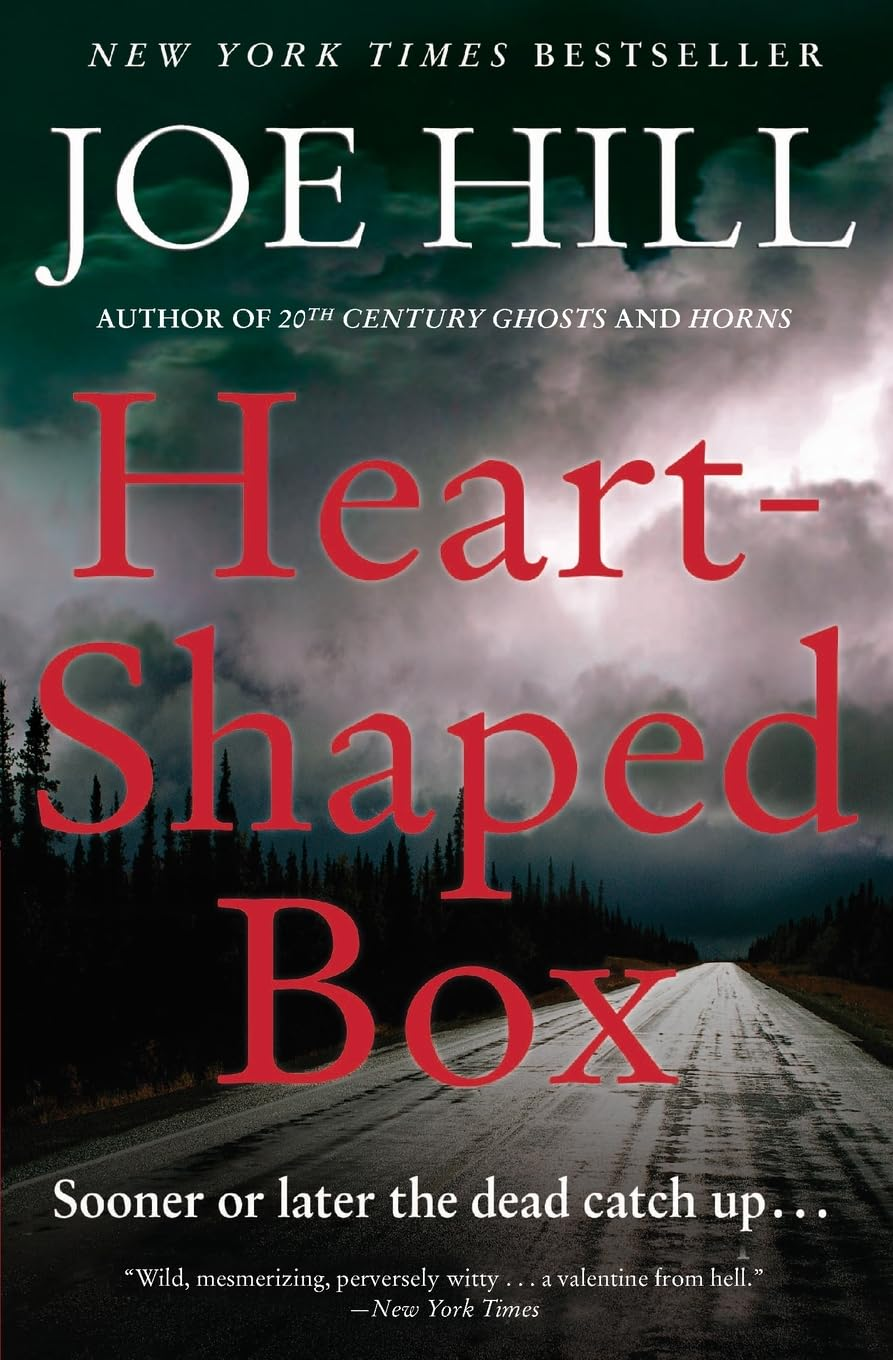
Heart Shaped Box by Joe Hill


"Buy my step-father's ghost." You'd think this was a novel idea, but it is something you can find on ebay today. I was going to link something here but got the heebie jeebies just searching for haunted items and don't need the bad vibes right now. Although I have to wonder, does it increase the value of an item to describe it as haunted? In either case, buyer beware!

Heart Shaped Box is Hill's first full-length novel, published in 2007 (he also published a collection of short stories two years prior to this called 20th Century Ghosts). I had read Hill's Horns and liked it. I have also heard good things about Nos4A2, but haven't gotten my hands on it yet. In the meantime, Heart Shaped Box landed on my bedside table.

The owner of said box is Jude Coyne, a rock star who likes to collect macabre items like the skull of a trepanned peasant which makes for a good pencil holder, apparently. And after looking up what trepanning is, I get it. So when he sees an ad for a ghost, he can't resist, throws caution to the wind, and goes all in with the "buy-it-now" button - to hell with bidding! Of course, the seller doesn't believe souls can be sold, so they send the dead man's suit, hoping the ghost will follow.  

Jude quickly starts experiencing strange things. Some subtle, like how his girlfriend pricks herself on an unseen pin in the suit, and some more obvious, like seeing a man sitting in the chair in his hallway. The action starts quickly and doesn't let up in this story. And Hill is great at taking fairly mundane things, like describing eating a chocolate covered cherry, and turning it into something macabre - like biting into an eyeball.

This is a fun story about a haunting, but it also involves deeper questions about the things that tie people to one another, in this case death. Through his characters, Hill addresses various stages of death - pre with Coyne's love interests, post a la the ghost, and peri through Coyne's father who is on his deathbed. Hill explores how decisions you make in life can affect all of these stages. 

I am of two minds about this book. There are some really great things going on that I dig - like how Hill can transition so quickly and seamlessly into horror. While I wouldn't describe the book as scary, it definitely has satisfyingly creepy moments and the pacing of the story is just right. There aren't long lulls in the action. 

But there are other things that give me the ick - like a scene that mixes violence and sex, references to a snuff film, child sexual abuse, and the ~30 years age difference between Jude and his girlfriend.  

So while I think overall it's better than it was worse, consider yourself warned!

Monday, March 4, 2024

Slenderman: Online Obsession, Mental Illness, and the Violent Crime of Two Midwestern Girls by Kathleen Hale


In 2014, in Wisconsin, a young girl was nearly killed. There were a number of reasons this case was unusual, but among the top were that it was perpetrated by two 12-year old girls and that the apparent motive revolved around the fictional and internet-famous Slenderman.

While this sounds fascinating, it was less about Slenderman and more about the delusions kids can talk themselves into. What was more relevant is the fact that one of the two girls was experiencing undiagnosed schizophrenia at the time. It was a perfect storm of mental illness, impressionable underdeveloped brains, and a fascination for the macabre that culminated in the near death of 12-year old Peyton Lautner on her twelfth birthday.

This true-crime novel is told mostly from the perspective of one of the offenders, Morgan Geyser. This is due, in part, to the Geyser family's willingness to work with Kathleen Hale on the book. But Hale still does her research and provides an in-depth account of the events leading up to, during, and after the attack. But because of the fact that Lautner's family didn't work directly with Hale, her perspective and struggles through these events are not as prominent as the experience of the offenders. 

With that in mind, I found Hale's analysis of Geyser's experience in custody terrifying as a parent. The roadblocks Geyser faced in getting medical care were an additional tragedy that is probably all too common in any U.S. detention system. And depending on your personal beliefs, you may also find it tragic that two 12-year old girls were interrogated without legal counsel and found to be tried as adults for their crimes.

You may go into this one thinking you'll learn about a horrific crime, but you'll also come away with a horrifying look at our criminal justice system, especially for juveniles.


Saturday, March 2, 2024

In An Absent Dream (Wayward Children #4) by Seanan McGuire


If you aren't familiar with this series, it begins with Every Heart a Doorway, a novella about Eleanor West's Home for Wayward Children. West runs a boarding school for children who have been to other worlds and returned unable to readjust to regular life. Every Heart a Doorway introduces a lot of children who have traveled to these worlds, but doesn't really flesh out individual stories.

McGuire's subsequent books explore these individual stories. One of the great things about this series is that you don't really have to go in order. While there are some threads between books, you really can read them as stand-a-lone books.

In an Absent Dream is the story of Katherine. She's a rule-following girl who always listens to adults and does what is expected of her. Her father is her elementary school's Principal. And because of this, Katherine finds it hard to make and keep friends and feels disconnected with her family. One day, she strays from her normal path home and finds a door in the trunk of a tree. Of course she decides to see what is inside.

Beyond this door, Katherine discovers the Market, which has rules that must be followed based largely on fair value and making and keeping agreements. As a young child, she is given leeway in the agreements she makes and others are allowed to take on debt she incurs. She develops a friendship with another girl and is mentored by a mother-like figure during her visit, which eventually ends.

Upon returning to the normal world, Katherine, who now goes by her surname, Lundy, tries to adjust to normal life. The mystery of her disappearance is an open secret by those around her, except to maybe her father, who seems to know something about her experience. 

As she grows older, Lundy travels back and forth between worlds, learning more about the Market and the importance of paying back debts, including those her dear friend took on during Lundy's first visit. But Lundy also develops a deeper relationship with her sister, and subsequent visits to the market are interrupted as Lundy travels back to keep commitments to her family.  Lundy knows however, that the flexibility given children by the Market will soon fade and she will eventually be forced to decide between the two worlds.  

In An Absent Dream is a short story about another world that might not be perfect, but might be just what Lundy is looking for. It's interesting and dark and fun to read about, but I feel that there is a certain spark that is missing that could elevate this book to a higher level. I'm not sure what exactly it is: that the books are too short to dig deeper, or that the Market isn't a world that speaks to me. 

One of my criticisms about Every Heart a Doorway was that the individual stories weren't fleshed out enough so I appreciate these individual stories. While I feel there could be a lot more said about Lundy's world, I think what we got was just enough to get the point across in this short story.

Monday, February 19, 2024

Blindsight by Peter Watts


This book was so good, I read it twice. And I don't mean, I read it years ago and wanted to read it again. No, I read it (or rather, listened to it) about a week ago, finished it feeling I hadn't retained much, and then immediately re-read it. 

On the first go, I was constantly confused about what was going on and who the various characters were. I couldn't even really say what the basic plot was. This probably isn't making my case that this is a good book, and I wasn't feeling that way either. But despite this, I realized I was never bored while listening, and I liked a lot of the ideas I heard, it was just so dense with information that anytime I tried to multitask, I'd miss something (one of the pitfalls of listening to my books instead of reading them).

So I checked some blogs online, brushed up on the basic plot and characters, and tried again. This time, I focused on really paying attention, cut out the multitasking, and it paid off.

Blindsight is a hard science fiction book, written in 2006 by Peter Watts. It's full of interesting concepts like, well, blindsight, first of all, which is the ability to perform a task without consciousness. An example given in the book occurs when a person is temporarily blinded, yet is able to react to visual stimulus. This article, from the BBC, explains the concept much better: 

"Just how many of our decisions occur out of our awareness, even when we have the illusion of control? And if the conscious mind is not needed to direct our actions, then what is its purpose? Why did we evolve this vivid internal life, if we are almost 'zombies' acting without awareness?"

This quote could have been pulled directly from Watts' book. In fact, he also brings up the concept of zombies in a similar context. Watts explores consciousness as an abnormal, evolutionary quirk. Perhaps, humans are flukes of nature, slowed by our sense of self. Could there be intelligent life that isn't self-aware? What benefit to survival does consciousness actually provide?

Watts also includes concepts of AI, the observer effect, von Neumann machines, Turing machines, game theory, and even vapirism.

All is presented in the context of a society that is a few years away from achieving a single consciousness. The need for bodies is fast in decline - people can upload themselves to "heaven" while their bodies lay in storage, sex in the first person is considered old-fashioned, body modifications include brain treatments and tweaks, and alterations abound that basically turn people into biomachines.

Our narrator, Siri Keeton, underwent a hemispherectomy as a child to treat epileptic seizures. The debilitating surgery took most of his ability to have emotions, but enabled him to become a synthesist - someone who takes vasts amounts of complex information and relays it to others in a coherent way. 

In 2082, the fireflies came. The world was awash in light due to alien probes that surrounded Earth and took a picture of its entire surface. Earth responded by sending Siri and four others (not including their backups, who would remain in stasis unless needed), to follow a signal believed to be coming from a comet. Blindsight begins with the crew waking up five years into their  journey, having gone off course, and severely overslept.

Their ship is Theseus, which is described anthropomorphically and run by an AI captain. It has some kind of user interface that all the crew can interact with called ConSensus that allows them to upload and share information and communicate remotely. Theseus's AI communicates exclusively with Jukka Sarasti, a vampire who has been resurrected from the Pleistocene era, to command the crew. There is also Isaac Szpindel, the biologist and physician, who can hear X-rays and see in shades of ultrasound. Then there is Amanda Bates, whose military background provides expertise relevant to the ship's and crew's physical security. Finally, we have the "gang of four." This is a person who had multiple personalities induced - the primary personality being Susan James, a linguist. Also inhabiting the same body is Michelle (another synthesist), Sascha (I'm not sure of her specific role), and Cruncher, a male who mostly stays in the background, well, crunching data.

The crew can all be considered altered in various ways, so much so, a normal person wouldn't be able to comprehend interactions between them, which might occur in various languages and even without known language, which would seem nonsensical to a layperson. "No real scientist would allow their thoughts to be hamstrung by  conceptual limitations of a single language...It's just that once you get past a certain point, formal speech is too damn slow!" So it is Siri's job to observe and understand everyone's intentions and relay this information back to mission command. 

Theseus travels to Big Ben, a quantum particle as heavy as 10 jupiters. There they encounter Rorshach, a sort of civilization? Factory? Well, they're not so sure, so they attempt to make contact. Unfortunately for them, Rorshach is rife with radiation that means any forays into its environs result in radiation sickness, which can include physical symptoms such as blindness, tumors, and eventually, death, but also psychological symptoms reminiscent of hauntings, loss of self, and possession. Each trip to Rorshach requires the crew to spend time in the ship's medical bay, healing from the effects of their trip. And then they do it all over again.

If you're still with me in this review, it means you're finding these concepts as fascinating as I did. I'd recommend this book to you with one caveat - it's dense and requires your full attention. Save yourself the second read-through and pay attention the first time around. You'll be better for it.

And for some extra fun, check out Watts' website. He has extra content relevant to the book as well as some of his novels available in their entirety. I checked out Blindsight and found there were notes and references that provided fun information like a primer on vampires and the physiology of the aliens encountered. I'm kinda annoyed that wasn't a part of my audiobook. I also found some great art made for various versions of the book, and learned there is a sequel to Blindsight, called Echopraxia, so it was definitely worth a look.

Saturday, February 3, 2024

The September House by Carissa Orlando


Have you seen the show Ghosts? It's a campy sitcom about a woman who sees ghosts in her house and has learned to live with them. This is kinda like that, but a lot more macabre, and a lot more funny!

If it isn't bad enough to live in a haunted house, try living in this haunted house in September! The ghosts act up more than usual, the walls bleed profusely, and forget about sleeping, with all the moaning and screaming. But Margaret is resigned to this. She's learned to adapt, ignore, and tolerate all the goings on. She's tried the usual remedies: priests, microfiche research, ouija boards, digging up bones, and more. But eventually things go back to the way they were, and of course, there's always September.

Take Elias, for example. The boy who doesn't speak but howls, and bites if you get too close. Margaret has learned to just treat him like a plant, narrating her life around him, while expecting no response in return. And it works! Unless she gets too close of course, but shame on her for crossing his boundaries. Margaret understands that if she follows the rules, bites will be kept to a minimum. 

In this way she has managed to figure out what triggers each ghost. If you don't want the upstairs bedroom ghosts to crawl out of the fireplace, don't start a fire! Easy! And sometimes avoidance is best, which is the case for Master Vale, who lives in the basement. The Bible pages attached to the back of the door seem to be doing the trick, as long as the door stays boarded up. 

By playing by the rules, Margaret has learned to coexist in this crowded house. But her husband, Hal, isn't quite as understanding and leaves. And this is news that she can only hide from her daughter, Katherine, for so long. Eventually, Katherine insists on a visit to figure out where Hal went. Unfortunately for Margaret, this is in the middle of September, when even the best behaved ghosts find themselves relieving their anxiety by rearranging the furniture a la poltergeist style:


Unfortunately, this also means the door to the basement has to get unboarded, in order to avoid more questions about what's...down there. 

What's great about this book is how a lot of what goes on can have an alternate meaning to an outside observer: Frederika, the helpful (dead) housekeeper, likes to make tea for Margaret. But all Katherine knows is that the stove is on and left unattended constantly. Or Katherine will catch Margaret talking, seemingly to herself. And signs that Margaret sees as other worldy messages are seen as meaningless noise by Katherine, who grows increasingly worried for her mother as she observes more and more bizarre behavior.

Just like the plot of a typical sitcom - misunderstanding abounds and hilarity ensues, with a touch of horror mixed in. This is a great read that will keep you entertained the entire time.