Sunday, February 15, 2026

The Night Guest by Hildur Knútsdóttir

After finishing this one, I thought, "well that was a sweet little horror novel." I'm not sure I can verbalize why sweet is the best word, but it really is. 

Maybe it's Mary Robinette Kowal's subtle hints of humor alongside the terror in her voice as she narrates Iðunn (pronounced Ethun) in Knútsdóttir's novella. I rooted for Iðunn and was horrified alongside her as events unfolded. I wanted Iðunn to wake up feeling refreshed, not like she just walked 5 miles or wrestled a bear. What other explanation could there be for the soreness, bruises on her body, and blood under her nails night after night?

Maybe it's the book's format of 100+ chapters - but many just a single sentence. It was nice not needing pages and pages of explanation and exposition. It's really quite simple, Iðunn isn't sleeping well. In her journey to figure out why, she tries psychotherapy, sleeping pills, insomnia, dating distraction, GPS, and a step-counting app. Despite the overall brevity, Knútsdóttir still managed to create someone you care for and seem to know pretty well. 

It definitely wasn't the sinister undertone of Iðunn's morning revelations.

Or the cats.

And it wasn't the reveal. Definitely not the reveal, which I'm a little flummoxed by, to be honest.

But somehow, at the end of the day, I was able to listen to this novella in a few hours and got a fun head scratcher out of it. Unconventionally, horrifically, sweet. 

Sunday, February 8, 2026

Pride and Prejudice by Jane Austen

This is a part of my quest to read those books I feel like everyone had to read in high school, but somehow I didn't. My goal? To know what people are talking about when they reference this book, and to hopefully understand the source material for some pop culture references.

Well, now that I've finished the book, I realize I overestimated the pop-cultural currency this book contained. I don't feel like there were moments where I said, "THAT'S where that came from!" And I didn't get to understand why Jane Austen is such an amazing author (I'll duck if you want to throw shoes at me now). 

Set in the early 1800's in England, I at least hoped to get some interesting details about life in that time. But it was a long slog of ladies gossiping and talking about marriage and visiting homes to realize there wasn't much that I would take with me. And I feel like not much really happened. It was just all he said this and she said that and NO I WON'T marry you! And blah blah blah. I'm sorry, did I miss a tea time at some manor while I was sighing for the millionth time? But someone might have gone on holiday and I'll never know!

I guess I didn't like the book. But will I watch the movie? Yes I will, if for no other reason than to see if in my utter boredom I missed a good part or not. But I'm pretty sure I didn't and if I did..


Sunday, February 1, 2026

Project Hail Mary by Andy Weir

If you liked Andy Weir's first novel, The Martian, then Project Hail Mary won't disappoint as another witty, funny, creative sci-fi adventure. Suspend your belief for this one, as moments of sudden clarity, synchronicity, and serendipity abound. But in order to save the world, everything has to fall perfectly into place, and I was here for it!

In some ways, Weir's protagonist, Ryland Grace, is an everyman archetype - an unassuming middle school teacher with no real drama or intrigue in his life. But in other ways, he's the smartest, luckiest, most well-equipped human in the universe. If you can get past all of that (and I think Weir is able to get us to that point) then PHM is a great story. 

We open to Grace waking up and not remembering where he is or even who he is. But he seems to be in space, which is a problem when you have amnesia...aaaaand have never been in space before. Grace slowly regains his memory through snapshots of his life back on earth. So we get the alternating timelines as a way to reveal why Grace is in a spaceship trying to save the world. To complicate things, there is an unknown vessel near grace's ship that he isn't sure is from earth. But he has to make contact with it in order to complete his mission.

Weir is great at giving us so many scientific details in an easy to understand and relatable way. And Ryland Grace is a smart, funny, and entertaining narrator. And the story itself, about how the sun is dying and what is causing it, is thoughtful and interesting too. 

For more information about Weir and his work, here is his website. And here is a link to the trailer for the movie, coming out next year, added bonus - it stars Ryan Gosling.


Saturday, January 24, 2026

Ghost Station by S. A. Barnes

I was going to say this was a first for me in terms of genre: space horror. But now that I think about it, I was introduced to space horror in the 90's when I went in cold to see Event Horizon and walked out of the theater in horrified silence. THAT shit was space horror. 

But we'll take it down a notch and talk about Ghost Station, which is set on an alien planet with a long lost civilization. We follow a team of explorers to this planet which includes psychologist Dr. Ophelia Bray, who is there to help them deal with the recent loss of a team member. But she is also there to screen them for signs of ERS, a debilitating space disease that results in psychosis.

While it can be assumed Dr. Bray won't immediately be accepted as a part of this already established team, she can't help but feel like there is more they aren't telling her. The leader of the team doesn't support her presence and the others' treatment of her range from indifference to outright resentment.

As they explore this long abandoned planet, the team's grief over their lost teammate, coupled with disturbing discoveries, make it difficult for Dr. Bray to discern if someone's behavior is due to grief, deception, or emerging signs of ERS. 

Of course, Dr. Bray isn't immune to developing ERS either, and her past, which slowly unfolds for us, makes her wonder if she might have a predisposition for it, because her team aren't the only ones acting strange at times...

While this wasn't Event Horizon level space horror (and let's be real, thank God for that), it was a solid read. I'd pick up another one by this author, who apparently writes a variety of genres, from YA and Romance (as Stacy Kade) to horror (as S.A. Barnes).


Saturday, January 10, 2026

Greenlights by Matthew McConaughey

I'm not a memoir reader. But this was gifted to me during a happy hour, when my defenses were down and I was probably more excited than normal to receive a gift. All jokes aside, I will admit that one of my favorite books, The Glass Castle, is a memoir, so when Greenlights arrived in my audible account, I decided to waive judgment. But I felt like, of all the memoirs out there, is McConaughey's really going to be the one to change my life (as promised during said happy hour)?

I'll admit, having McConaughey narrate his book makes it ten times better. You literally hear his drawl and get all the nuances, jokes, and emotions he conveys on the written page. His penchant for writing is clear, as his stories, anecdotes, and poems roll off the tongue with ease. He has the voice of a spoken word performer, and given that his upcoming book is a collection of his poems, that doesn't surprise me.

His stories show his free spirit and big heart. His entrance into acting and later success seem oddly coincidental, as he got into acting in his 20s and might have just been in the right place at the right time. His overall theme of recognizing the green lights in your life and turning red and yellow lights into green was a great metaphor for life's ups and downs. And it was fun to hear him tell a story and then proudly declare, "green light!".

But at the end of the day, will this book change my life? No. Was I entertained while reading it? Yes. I'd definitely recommend the audio version though to get the full effect.

Sunday, September 14, 2025

The Southern Book Club's Guide to Slaying Vampires by Grady Hendrix

Grady Hendrix and I have an on-again off-again relationship. I didn't like Horrorstor, but I appreciated the premise and the book itself in terms of the illustrations included. I enjoyed How to Sell a Haunted House enough that I decided to try The Southern Book Club's Guide to Slaying Vampires and give him another chance. I will give him credit for being an author that I picked a random book from because of name recognition. So there's that working in his favor.

But we are back in a slump, unfortunately. Here's my list of notes during reading:

  • All the characters are terrible
  • When trying to figure out if James is a predator, all kinds of excuses are offered to let him off the hook, but the fact that Patricia actually SAW him violating a girl is just ignored
  • Patricia's husband treats her like a child
  • Book relies on coincidences (like a nosy neighbor logging license plates)
  • "...it was a white monstrosity painted white..." What color was it again?
  • Patricia had a sex assault victim take a shower before going to the hospital (she is a NURSE obsessed with true crime novels)
  • Husband upon hearing his daughter has a drug problem "This is from YOUR side of the family" It was just a stupid line, which I get is the point, but it grated on me
  • This poignant quote: "...'Mary Ellen!' Mrs. Green shouted, using her first name..." 
  • The women act like female Peanuts characters (i.e. bitchy, frowny-faced, accusatory children)
  • Patricia KNOWS James is a predator and is trying to convince everyone of this, yet it's ok for her son to stay at his house.
  • The husbands' solution to the women accusing James of heinous things is to have him join the wives' book club...like, what?
Having said all of that, Hendrix might be turning into a guilty pleasure for me...because I was interested in the story. Even though I hated all the characters and could use the plot to strain spaghetti, I still wanted to know how it ended. And it didn't irk me enough to write off Hendrix forever. By managing my expectations and not taking his books too seriously, I'm in a better headspace to handle the annoyances and let the absurdity wash over me. And I suppose there's a place for that in my reading life, with the right mood and expectations.


Saturday, March 22, 2025

FantasticLand by Mike Bockoven


If you strand a bunch of (mostly) 20 something year old adults who work in a theme park for 35 days during a natural disaster, what do you think would happen?  If you're hoping for Temptation Island level hijinks, you'll be sorely disappointed. But if you're leaning toward murder and heads on a stick level violence, then this is the book for you! Think Lord of the Flies, but with adults and multiple tribes.

This book works for a lot of reasons. First, you have basically everything you need at a theme park, food, water, shelter, commercial goods...and then you have a lot of other fun things too, like pirate coves and circus tents and underground tunnels. So there are a lot of different directions things can go, and they certainly do. 

What doesn't work for me though, is the format of the storytelling. The book is a series of interviews conducted after said events. While this is great in that you get a lot of perspectives, you also don't get too much depth from anyone in particular. And the book reads more as a series of short stories rather than a cohesive narrative. 

Another point, if you're listening to the audio book, each chapter is told by a different person. Since these are interviews with "normal" people, there is a lot of throat clearing and "but you're not asking about that..." or "I'm getting off track" sort of comments. It's fine every now and then, but it's an overused device, in my opinion. Obviously, this is written into the book as well, but it came across more as a bad reader's theater (remember those!?!). 

And while the story is overall entertaining, it's over the top. As I already mentioned, the people stranded at the park pretty much have everything they need to ride out the storm. Why then, do they devolve into tribes that resort to murdering each other pretty much on day one? We are talking cutting hands off and branding people level of depravity. But if you're willing to overlook the obvious "but why" issues and don't look too deep into the mechanics of the story, this can be an entertaining read. 

Take the tribes, for example. After the initial hunkering down, people split into various areas of the park. Those who inhabited the circus area are the Freaks, (my favorite of the tribes, by the way, for creating a circus-themed horror show). The most vile and violent went to the Pirate's Cove. There are also the shop girls, the Fairies, the Deadpools, the mole men, and the robots. Why the Deadpools have multiple amazing archers or the Pirates have an actual working cannon is beyond me, but we aren't here to look too deep into this.

Of course, not everyone is ascribed to a tribe, so there are a couple of miscellaneous but compelling stories peppered in. Like from a man who inhabited an empty hotel but was stalked by a mysterious couple or the story of a woman who helped run the med tent. 

This book seems like a great idea to spawn a TV series or movie. I feel like the ideas are there but could be developed into something more. While it was overall entertaining, but just had me wanting a little more.

Grown Women by Sarai Johnson

Sarai Johnson teaches writing and literature courses at Howard and American Universities in the DC Area, and apparently wrote Grown Women, her first novel, in her free time. In my free time I do things like sleep, or sit around and do nothing, or make lists of things I should be doing. Okay okay, I also read the product of other people's free time.

Which bring us full circle to Grown Women, a novel about four generations of women, with the story beginning in 1974 when 19-year old Charlotte leaves home after giving birth to her daughter, Corinna. Out on her own, Charlotte struggles to create a stable life for her and Corinna. Despite Charlotte's upscale upbringing, she doesn't reach out to her mother, Evelyn, for support. And she never talks about the reasons she left home for the backwoods of Tennessee. When Corinna turns 18, she conceives her daughter Camille with a man whose life trajectory doesn't include them, at least not publicly.  Together, the three generations of women navigate life, often through increasingly contentious moments.  

After things between Corinna, her husband Isaac, and Camille come to a head, Corinna turns to Charlotte for help. Seeing that her help can only go so far, and wanting to provide Camille the best possible outcome, Charlotte eventually turns to Evelyn for help, which makes them face their past and reconcile it with the present.

This isn't a story with a specific destination or bad guy. It's more about how life can be good sometimes and bad other times. It's about the decisions we make daily and those closest to us. Amidst the usual struggles of making ends meet, raising a child, and finding a partner, Johnson peppers in the unusual struggles of suicide, homicide, and abuse. She also examines generational trauma and how it spreads for decades in unspoken ways. We experience how these women try to overcome that trauma and stop perpetuating the pain it inflicts, and the messy process that comes with all of it.

I'll be honest, this isn't a book I would normally pick up. It doesn't have a catchy premise or strange twist. But it's about struggles we have all dealt with and is told in an engaging way. And for a debut novel, it makes me curious about what Johnson writes next.  

Saturday, March 15, 2025

The Power by Naomi Alderman


This is a story that Alderman describes as feminist science fiction - a type of speculative fiction that I like to call a "what-if" story.

The Power examines how power comes in various forms - whether physical, societal, something you are born into, something you can take from someone...and the list goes on. Alderman explores what happens when women develop an organ called a skein that enables them to deliver electrical shocks. Their inherent ability to physically overcome any man changes the balance of power in the world entirely. 

The Power is written as a manuscript of these events, having taken place thousands of years earlier. It catalogs the emergence of this new power eight years prior to a cataclysmic event. There are several stories we follow including a journalist's careful observations of women's use of their power, two women in government positions, one in the US and another in the fictional Bessaparra, and other women who have experienced violence by trusted men in their lives including Roxy, the English daughter of a mobster, and Allie, whose grasp of The Power leads to her god-like status among some.

As you can imagine, each take a different approach to what they think women's new role in the world should entail. Of course there are some who are more militant than others and some who are more benevolent than others. I guess the overarching question is, will things be different with women in charge? Or will those in power fall into the same traps as their male predecessors?

The Power has a televised series (on Prime Video) that is fantastic. It might be one of those rare instances where I prefer the televised version to the book. But that's not to say the book isn't worth reading. It's an interesting premise that explores a lot of thoughtful questions, but you'll want to check out the show after reading the book


Saturday, March 8, 2025

Mexican Gothic by Silvia Moreno Garcia

Moreno Garcia does an amazing job setting the right mood in this newer gothic tale. Set in Mexico in  the 1950's, you forget that the world is more modern than what Noemi Taboada experiences. Having grown up in Mexico City to an affluent family, Noemi's life is more about finding a worthy suitor and getting married than education or developing skills to join the workforce. 

Despite this, Noemi is a confident, charming, smart woman who would like to study at the University. While she enjoys fancy parties and delightful banter, much like a Disney princess, she wants moooooooore...Her father reluctantly agrees if she will first travel to a rural town to check on her recently married cousin, Catalina. 

What follows is a tale set in an isolated home on a treacherous hill complete with a foggy cemetery. Although it's the 1950s, the home doesn't have electricity and is intentionally kept dark and quiet. There don't seem to be telephones as everyone corresponds by letter. And dinner is in silence at the behest of the family patriarch, the mysterious Howard. There's also a lot of snake references, botany, nightmares, old mining lore, and a family secret.

Speaking of family, we have the wistful and delicate Catalina, who only speaks in riddles (because why can anyone speak plainly to explain a situation), and who has brought Noemi due to the strange letters she sent. There are also servants who act like NPCs, Catalina's seductive and questionably evil husband Virgil, the strict buttoned up Aunt Florence and her meh son Francis. Throw in a few doctors and a mysterious healer who trades town gossip for cigarettes and you have your complete cast of characters.

At the end of the day, this is a strange story and I'm not sure what I think about the punchline. It's somehow not based on a novel idea, but definitely different in execution. If you've read Children of Ruin or The Girl with All the Gifts, you'll definitely see some parallels, and these are all really different genres. I'm also reminded of Riley Sager's books, which have similarly interesting, if not a little fantastical, stories. 

This book took me awhile to finish. I'd start and then get distracted and start again and finally got the audiobook and powered through it. I don't know if I'm just better at listening to audio books or if was a great narration, but I enjoyed my final attempt much more than the first two. But not getting hooked right away makes me ambivalent when it comes to seeking out Moreno Garcia's other books. While I won't go out of my way to reach for another one, I'd be open to a recommendation.

Children of Ruin by Adrian Tchaikovsky

Tchaikovsky has a knack for making humans supporting actors in his space-faring opera about intelligent animal life. After reading Children of Time, which I enjoyed, I wasn't sure how he would do a second book about a different species in a fresh way. But this second book is just as good as the first.

Told in a similar way to Children of Time, Children of Ruin switches between the past and present. The past being a time when human civilization has basically self-destructed and sent ships into the universe to terraform planets for future civilization. The present being thousands of years after this - as well as several thousands of years after Children of Time. It's amazing how space time really stretches things out and how quickly you get used to the vast stretches between years.

What we get from this second book that wasn't as fleshed out in the first is more about the terraforming project and how it works on a practical level. What we don't get is a lot of detail about our alien friends and how they develop their civilization. But that is forgiven when you learn their own civilization is basically destroyed, hence the ruin. What's intriguing, and what really steals the show is why this ruin occurred. Tchaikovsky has created an existential enemy that is both exciting and terrifying. I loved any scene that involved them. 

Children of Ruin explores themes of AI, immortality, the self, and invasion - both on a planetary as well as individual level. And while I felt he ended things a little too easily, I'll forgive him that because overall it was another great story in the Children of Time series. I can only hope his super villains will come back in subsequent novels, because they really were horribly fun.

Sunday, December 29, 2024

The Husbands by Holly Gramazio

I love "what if" books, where you have a premise that the author just goes with, no matter how out there it is. And the question of how or why really isn't the point. I think Jose Saramago is great at what ifs, but reading his books requires a degree of patience and concentration that Gramazio doesn't demand.

So, what if...a husband emerged from your attic? Forget the fact that you're not even married, or that you have an apparently magic attic. What would you do? What if, every time your husband went into the attic, he disappeared and a new one came out?

Could it be fun shopping for husbands? That one's too tall,  that one's wearing a terrible shirt, that one chews too loudly. And even if you get a good one, you can't help but wonder if he's the best the attic has to offer. Then there's the business of how to get the bad ones back in the attic and how to keep the good ones out of it.

As I'm writing this, I'm realizing how incredibly misandrist this sounds, but hear me out! Gramazio is able to take this premise and write a compelling and very funny story. Coming off of reading The Three-Body Problem, I'm starting to realize Lauren's life in The Husbands has its own periods of stability and chaos. And even the so-called stable periods, where she doesn't immediately send a husband back to the attic are filled with tension - if she likes him, how will she keep him from fetching that much needed box up there? If she doesn't like him, how will she get him back in? And what I like the most is how Gramazio shows the multiple variations of Lauren's life had she just made slightly different decisions - and how this affects her relationships with her friends and family. There's rich Lauren, poor Lauren, swinger Lauren, her best self Lauren, the Lauren who married her ex, and more.

And then there's Bohai, one of Lauren's husbands who seems to know more than he lets on when he comes down those attic stairs. I feel like Bohai needs his own book. He was such a fun, well-written partner. I loved any chapter that had him in it.

So what would you do with a magic attic? Would you embrace its power? Or run for the hills? Whether or not you agree with Lauren's choices, you'll love seeing her make them.

Saturday, December 21, 2024

The Three-Body Problem by Cixin Liu

*some spoilers ahead*

If you, like me, had never heard of this book until Netflix aired the eponymous series, it's ok. Sometimes we watch the movie/tv show/whatever and then read the book, even though it feels weird. 

Three-Body Problem is a concept in classical mechanics that describes the motion of three masses that orbit each other in space. The problem is that there is no solution to always accurately describe their motion (thanks wikipedia). 

So now imagine there is a planet, called Trisolaris, with three suns. The positions of the suns are unpredicable and can result in times of stability or chaos, depending on how close each of the suns gets to the planet. In fact, multiple civilizations have evolved and died out on Trisolaris. Some exist for relatively short periods of time, some long enough to get to the stone age, or the industrial age, before a chaotic period begins and destroys all of civilization.

But this book is less about Trisolaris and its inhabitants and more about earth and its inhabitants. What if there was a group of people who knew about Trisolaris? What if they wanted to help the Trisolarins find a new planet to inhabit? Much like the political climate today, there are some who would say, "bring 'em here! I don't care if humanity is destroyed in the process!" and others who would try to solve the three-body problem so they could stay where they are.

But part of the problem is that someone has already invited them to earth. And even though the journey is 450 years out, the toothpaste is out of the tube, as they say. But 450 years is a lot of time for Earth's civilization to evolve and improve while the Trisolarins remain static in their journey. So the Trisolarins invent a unique solution to stall scientific progress on earth. And this is where the story begins, with the suicide of several notable scientists, and a task force created to understand why.

This book blends a lot of scientific principles in a fairly easy to read story. It also deals with issues related to China's cultural revolution, environmental preservation, and scientific progress. While it's not my favorite sci-fi book I've read this year, I'll be picking up the second part of this trilogy to see what happens next.


Children of Time by Adirian Tchaikosky

I read this book to get my brother to stop talking about alien *insert creepy animal here (I don't want to spoil it)*. Every time I'd see him, he would ask if I read Children of Time and then proceed to explain the premise as if he hadn't explained it to me the last time I saw him. After maybe the fourth or fifth time I decided to read the book to shut him up.

Look, I'm not a big sci-fi reader, but this one did actually sound interesting to me. It's about how Earth begins terraforming planets to prepare them as possible future homesteads for humans. Part of this plan involved developing a nanovirus to speed evolution in a selected species, allowing it to quickly evolve on one of these planets. This was a hail Mary in case the human species didn't survive.

Most of the book occurs thousands of years after these efforts, when humans only have faint memories of the "old empire" that carried out the terraforming and nanovirus projects. A spaceship of hundreds of cryogenically sleeping people has set out to find one of these planets and inhabit it, as Earth is increasingly becoming uninhabitable. After finding a potential planet, they are stopped from landing by what seems to be a keeper of the planet. It's unclear if they are communicating with a human, AI, or a combination of the two. But what is clear, is the entity will do everything in its power to protect the planet and its children.

A great aspect of this book is that we get the perspective of the inhabitants on the spaceship but also the inhabitants of the terraformed planet. While I was less interested in their day to day life and politics (which was still interesting), I was fascinated by their idea of religion, which involved the mysterious keeper of their race. The premise provided a great way to explore the idea of a species origins and the development of religion. While it seems plausible to understand how this civilization came to its beliefs, it really makes you wonder about your own.

This is the first of three books in the Children of Time series, which was awarded the Hugo award for best series in 2023. I liked this one so much, I'll pick up the next, Children of Ruin, which is about a different terraformed planet. I haven't heard anything more about the plot, which probably means my brother hasn't read it yet. I'll have to read it first and tell him all about it! 


The Women by Kristin Hannah

So there's good news and bad news. Good news is, I loved this book. Bad new is that I had my top five already written up before I finished The Women, and now I have to rewrite it. It's definitely worth the extra work though (although the book that got booted might disagree).

The Women is set during the Vietnam war and follows the path of Frankie McGrath, who comes from an affluent family that proudly celebrated military service. Following the path her brother took, in 1966, idealistic 20-year old Frankie impetuously enlists to serve as a combat nurse. Her experience is so minimal that the only branch that will take her is the Army. And it's with them that she spends two years in Vietnam, treating not only servicemen wounded from the war, but local Vietnamese as well. In addition to seeing the horrific wounds caused by guns, bombs, and napalm, Frankie experiences attacks on the hospital and the loss of loved ones.

I couldn't believe Frankie's time in service took up only about a third of the book. It was so packed with information and so fascinating that I just couldn't understand what more there could be that was as memorable. But Hannah delivers from the first page to the last, continuing Frankie's story until 1982. 

After her 2nd tour, Frankie returns home to people spitting on her and cursing her for her service. Her  family denies she was ever in Vietnam, having told their friends she was studying abroad. Even the VA turns Frankie away after she seeks help dealing with her nightmares and anxiety, telling her "women weren't in Vietnam." 

With her family's refusal to acknowledge the war, the military's lack of support, and her closest friends hundreds of miles away, Frankie doesn't know how to keep her life together. And being with her through it all is captivating. Sure, this book is about the Vietnam war, but it's more about trauma. Hannah manages to remove the stigma of a lot of things Frankie deals with, like drug abuse, PTSD, and psychosis. She walks us through the metamorphosis of a bright-eyed, naive young girl to a broken, lost woman. And it all makes sense and feels so deeply personal.  

While the story is primarily about Frankie, The Women is ultimately about all the women who served in Vietnam, like Frankie's best friends Barb and Ethel. Although they and other characters play a smaller role, Hannah gives all of them dimension. And while they are all far from perfect, they are perfectly written. 

This is not just a good story, it has historical significance with themes that are still relevant today. Hannah's dedication to her research and to the women she honors is fully realized in The Women and I couldn't recommend it more!

Monday, December 9, 2024

I Was A Teenage Slasher by Stephen Graham Jones


This is an unusual take of the slasher genre that I found refreshing. Is that an appropriate word to use when talking about slashers? Probably not, but I'm not sure what would work better...it was gruesomely delightful. How's that?

I can't say it's the first of its kind - the story reminds me of Scream, or even, to a lesser extent, Cabin in the Woods, where there was a comical self-awareness of the genre embedded in the story. 

I was a Teenage Slasher is narrated by Tolly Driver, who was a teenager in a small town in Texas in 1989. He's looking back and telling us how he became a slasher whose killing spree ended up spawning the to be expected media storm but also a movie! If there's a trope involved in slasher stories, it will likely be in this book, but in a tongue and cheek way. And while Tolly isn't super knowledgeable about horror and slasher lore, his best friend, Amber, is. 

The event that preceeds Tolly's metamorphosis is a story in itself...a revenge massacre that is too out there to believe. And after that night, Tolly experiences strange symptoms that seem to give him superpowers, like night vision and super strength. But with these enhancements come a realization that they aren't to be used for good. Tolly and Amber try to understand what is going on and to prevent him from acting out, but nothing seems to stop his transformation. It's inevitable and there are rules that must be followed. But can he learn the rules and circumvent them somehow?

One comment about Tolly's narration, he speaks in a way that I found difficult to follow. His thoughts seemed disjointed and lacking in context. There were also a lot of characters who would say something and then say, "what" at the end, which I didn't really get. For example: "She break up with you already, what?" I don't know if that's a regional thing or not, but it seemed strange.

Or there would be a phrase or description I just didn't get, like this one: "We went all the way down to the gate then walked back along the fence to take the steps up like a citizen." Or there was this sentence, "Too, though?"

I think it's partially Tolly's way of speaking but there were a lot of these little things I'd come upon while reading that just made the book a little harder to get through. The story itself was okay, but more a vehicle to explore the premise, which is what I really enjoyed. It was overall a fun and clever read.   


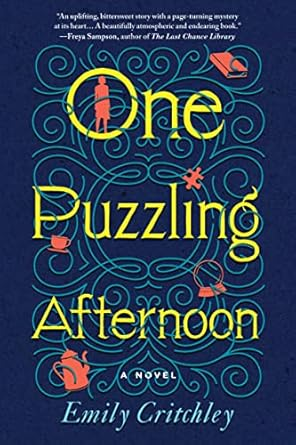
One Puzzling Afternoon by Emily Crutchley


This book follows what I find to be a common formula: an (arguably) unreliable narrator, and two different timelines: one in the 50s and the other in the 2010s. So we get bits and pieces of a mystery about a missing girl in alternating chapters. 

Our narrator is 82-year-old Edie (or 15 years old in the 1950's time-line). As a child, Edie is an outcast. She's poor and has an unusual home-life, as her mother performs seances. Edie meets Lucy, the mayor's daughter, and they become friends. While Edie adores Lucy and finds her life glamorous in many ways, Edie knows Lucy's love-life is a mess. While the handsome, popular boy is enamored with Lucy, she only has eyes for a much older, married man.

As an 82 year-old woman, Edie struggles with the onset of dementia. Thinking she sees Lucy one day sets her on an obsessive search of her own mind to remember what happened the day Lucy disappeared.

What works for me in this book is how Crutchley portrays Edie's dementia...how we see things from her perspective. Edie might say something that seems nonsensical to anyone else who doesn't know what she's thinking about at the time. But it makes sense to us, because we are privy to her thoughts. But that's not to say Edie is simply misunderstood, she's still suffering from dementia. So she might think she's in the 1950s timeline when it's 2018. But knowing that makes her responses make sense. 

I also like Edie's mother, who we don't really know is a fraud or not. There are definite indications that she is, but also indications she isn't. Is she accidentally right some of the time? Or does she have the gift of third sight without knowing it or fully understanding it? In some ways, she's like 82 year-old Edie. Not always making sense in the moment, but time has a way of bringing things together. 

While it's a good book, it wasn't one I couldn't put down. And much like those with that formula, it's fun in the moment and an easy read, but not one of my year's best. 

Saturday, November 16, 2024

Lincoln in the Bardo by George Saunders

Lincoln in the Bardo is a story that you chew on. You can't just sip it and multitask and hope to passively absorb it. You have to pay attention and actively read (or listen, in my case). But it's so rewarding when you finish it, and worth the extra mental effort.

If you're like me and thinking a Bardo is something like a bar, you are completely wrong my friend. In buddhism, a bardo is a liminal space between death and rebirth. So we are visiting this space along with Willie Lincoln, Abraham Lincoln's son, who died at age 11 from illness. Saunders uses both fact and fiction to weave a story of Willie's visit to the local cemetery after his death.

Willie meets a host of ghosts who have somehow avoided the judgement that sends them to their eternal fate, whether it's heaven, hell, or something in between. Saunders introduces various ghosts, each with their own backstory and...peculiarities...that have manifested in death.

Like Roger Bevins, who grows extra eyes, hands, and noses, among other things, when he can’t quiet his mind, which is pretty much all the time.

And there's the Reverend Everly Thomas, who has "eyebrows arched high...hair sticking straight up...mouth in a perfect O of terror." But despite his surprising appearance, he speaks with "the utmost calmness and good sense." If you're wondering why the Reverend hasn't managed to move on, his story delves into the judgement phase of death that we don't see with the others (and which was executed unnervingly in the audiobook).


Or Jane Ellis, who is surrounded by 3 gelatinous orbs - each representing one of her 3 daughters. Whether or not the orbs bear down on her, depart, or become life-sized manifestations of her daughters expressing a difficult situation, they cause Ellis severe distress. Also, sometimes Ellis saw everyone as a giant mustache with legs (which she despised of her husband).

And there's Mrs. Blass, once wealthy, but in death smaller than a baby, who gnaws at rocks and twigs, gathering and zealously defending them, counting and recounting her possessions, always short a few things.


And Trevor Williams - a hunter who has to briefly hold each animal that he killed, with loving attention while the animal is in the state of fear when it passed. And until that fear passes, he can't let go.


What the book reveals, that I won't, is each of their backstories - how they died and why they are stuck in the cemetery. Saunders makes each ghost unique and strange with paralleles between their lives and afterlives that are both compelling and at times, unclear.


What is clear, however, is that everyone is "stuck" in a way in the cemetery. Bound to the bardo. But there are ways to leave. In fact, a lot of the newly dead briefly come to the cemetery but quickly move on. But for those who don't, occasionally they are visited by sinister creatures, who come in a form most tempting to each individual and compel as many as they can to leave. Those who do, disappear with a lightning crack.


Another thing that is revealed is that the bardo is not a space for children. So when Willie shows up, the others become concerned after he lingers longer than he should. They don't want him to end up like Elise, the 14 year-old girl who ended up staying...


But there is something about Willie's father, who visits, and mourns, and holds Willie in death. Everyone sees something about him that makes them believe they can use him to help Willie leave.


There is so much to unpack in this book, which is strange, funny, and haunting all at once. You'll think about your life and death and everything in between. I'd say more, but I don't want to spoil some of the other themes that are explored in this book, mainly those having to do with why the ghosts won't leave the Bardo and the toll that staying takes on them.

A note about the format of this book: I listened to the audiobook and found myself scratching my head. There are so many characters who just...speak. Meaning, one person talks, then another, and there isn't any narration or even mention of "this person said..." or "replied this other person..." And there were a lot of characters, so I kept getting lost in terms of who was who.

So I was really curious about what the hardcopy text actually looked like. And when I saw the formatting, it all came together. Here's an example:

Efficacious

roger bevins iii

Yes, efficacious, thank you friend

hans vollman

So each character speaks and you know who it is by seeing their name below what is spoken. But that is lost in the audiobook. Although, the audiobook was great in that each character was a separate voice actor. So hearing Nick Offerman (as Hans Vollman) talk about pooping in his sickbox in the first chapter was a very rewarding experience, but also very confusing, because I had no idea what he was talking about.

The book is also written in alternating chapters. One is in the cemetery with the ghosts. The next is a series of citations, some real, some not, that gives context to the events leading to Willie's death. The citation chapters are also strange to hear via audiobook and might be a reason to pick up the actual book instead.

In the end, I listened to the last part of the book using both the audio and hard copy versions and felt like I got more out of it that way. I even went back and reread certain parts, which made more sense after I realized what was going on.

But whatever your medium, give it a try. This is a book unlike any other you've read. And it's worth the effort.

Mislaid in Parts Half-Known by Seanan McGuire


This is book nine in the Wayward Children Series, a series of books about children who have found portals into alternate worlds that can be the stuff of nightmares or dreams, depending on the child. 

A good thing about this series is that you could probably read the books out of order, since they deal with different children and worlds. But there are recurring characters and themes throughout, which might be lost by going out of order.

This book is about Antsy, who has a knack for finding lost things, which, as you can imagine, may include doors to secret worlds. Antsy finds herself and a group of friends, including a land-bound mermaid, a boy from a skeleton world, and a girl who died in a previous book, on a quest. They jump from door to door in order to avoid the wrath of Sarafina, a student with the ability to make people do anything for her. 

Eventually they land in Antsy's world, where lost things go. It's a nexus world, with a store for travelers. She worked at the Store of Lost Things, where people can open a multitude of doors and explore different worlds. In her case, Antsy used the doors for trips to buy supplies or opened doors for her employer to make visits to other worlds. Antsy eventually learned with every door opened, there is a cost, and she wants to hold the store owner accountable for not telling kids what that cost is.

This lore about the doors is interesting because it applies to all the books. We also get to see multiple worlds, including Prism, which is Cade's world, that he doesn't like to talk about (although I don't think this book does much to help in that understanding). While this is a great overall book for the series, with a lot of relevant information, I found it meandering in execution.

Once again, I am torn about these books. I know I'm not their target audience, as the series skews younger. But I appreciate the concept. The books are so short, however, you don't get a lot of world-building. And they deal with heavy topics like death, sexuality, and belonging in such short packages, that sometimes I feel it's not enough to really dig in. But I also am not engaged enough to want a longer book. I keep picking them up thinking, "this will be the one I truly love" and it hasn't happened yet. But I think they're great for junior high or high schoolers because they are so short and sweet, but still heavily packed with relevant topics.

So while I keep feeling meh about these books, there's something that keeps me coming back because they are so creative, if not fully fleshed out. 

Monday, November 11, 2024

Tales of a Fourth Grade Nothing by Judy Blume


I'm a little embarrased to admit that I'd never read a Judy Blume book. I know Superfudge and Are You There God? It's Me, Margaret were big hits when I was growing up. But I never picked them up, despite the fact I read a lot at that age.

And now, I have a son in 4th grade. And he was reading Tales of a Fourth Grade Nothing. So I decided to read it too. And here's my takeaway: 

Fudge is a terrible human being. Case in point: Fudge eats Peter's turtle, which makes him a monster. Full stop.

This book is supposed to be about Peter, but his 2 1/2  year-old brother Fudge consumes his life with awful, out of control behavior. And poor Peter has to constantly adjust and cater to it. It is so on brand that even a book about Peter ends up being about his annoying litter brother. 

Peter is well-behaved, hard-working, and responsible. His parents constantly ask him to do things to appease Fudge, or to stand aside while Fudge takes the limelight, or to redo his school project because Fudge destroyed it. 

I guess I had feelings while reading this book. I don't know if it's supposed to be funny, but I couldn't stop feeling bad for poor Peter while wanting to strangle Fudge. So I asked my fourth grader what he thought of the book and he agreed, "that kid's so annoying!"

So it's not just me or my adult perspective. Fudge is more horror villain than comedic device. But it made me feel something. And I guess that's the sign of a successful book, for better or worse.