Showing posts with label thriller. Show all posts

Saturday, September 28, 2024

The Ballad of Songbirds and Snakes by Suzanne Collins

Did you know Panem was pronounced "PAN-EM?" I sure didn't. You emphasize both syllables apparently. That's a benefit of listening to the audio book. But you know what might not be a benefit of an audiobook? Hearing a man trying to do female voices. 

Now, I'll admit that I listen to audio books at a fast pace, which obviously affects the vibe. But I couldn't help think that the females in this book sounded like female South Park characters. And it gets worse when some of those characters sing. To be fair, the narrator doesn't actually sing but listening to him quote the lyrics of songs while doing a female South Park impersonation is...strange. Suffice to say, I wasn't moved by any of the lyrics and I wonder if the experience would have been different if I were just reading them myself. 

I don't know, I feel like the lyrics to a lot of the songs sounded...basic. But honestly that's probably true of a lot of great songs. If you want to judge for yourself, you can hear all the songs on The Hunger Games website. I'm going to have to check that out as well as the movie.

Things I liked: There was a hunger games, but that wasn't what the whole book was about. We get an understanding of how the Hunger Games got to where they are once the Trilogy starts. I also hated Dr. Gaul, but in the way you love hating something. I also liked the lore about the Jabberjays and Mockingjays.

Things I didn't like: Pretty much any scene with a song. It seemed strange that Lucy Gray would perform on stage after being selected for the reaping. I get it in terms of her character and the plot and blah blah blah. But it just didn't resonate with me. It was not a realistic reaction or one that really solicited sympathy for her situation. But maybe I'm missing the point.

I also didn't like the idea of the Covey - a nomadic group without a real district to call home. That diluted the impact of the reaping for me. It seemed like Collins was trying to distance the Covey from the districts, almost to the point of saying they didn't deserve to be a part of the reaping. But is that to then say that people from the districts did?

And while the book is mostly about Cornelius Snow, I don't feel we really got to know him as a person. Sure, we learn about his family history and his actions and thoughts about things, but he still seemed two dimensional to me. I'm not sure if I was supposed to like him or not, but I was kind of ambivalent. There weren't many characters I liked, not even Lucy Gray. 

It's interesting in terms of getting background on the hunger games and Panem. But it's probably my least favorite of the series. And I would suggest reading the book, not listening to it. 

Monday, February 19, 2024

Blindsight by Peter Watts


This book was so good, I read it twice. And I don't mean, I read it years ago and wanted to read it again. No, I read it (or rather, listened to it) about a week ago, finished it feeling I hadn't retained much, and then immediately re-read it. 

On the first go, I was constantly confused about what was going on and who the various characters were. I couldn't even really say what the basic plot was. This probably isn't making my case that this is a good book, and I wasn't feeling that way either. But despite this, I realized I was never bored while listening, and I liked a lot of the ideas I heard, it was just so dense with information that anytime I tried to multitask, I'd miss something (one of the pitfalls of listening to my books instead of reading them).

So I checked some blogs online, brushed up on the basic plot and characters, and tried again. This time, I focused on really paying attention, cut out the multitasking, and it paid off.

Blindsight is a hard science fiction book, written in 2006 by Peter Watts. It's full of interesting concepts like, well, blindsight, first of all, which is the ability to perform a task without consciousness. An example given in the book occurs when a person is temporarily blinded, yet is able to react to visual stimulus. This article, from the BBC, explains the concept much better: 

"Just how many of our decisions occur out of our awareness, even when we have the illusion of control? And if the conscious mind is not needed to direct our actions, then what is its purpose? Why did we evolve this vivid internal life, if we are almost 'zombies' acting without awareness?"

This quote could have been pulled directly from Watts' book. In fact, he also brings up the concept of zombies in a similar context. Watts explores consciousness as an abnormal, evolutionary quirk. Perhaps, humans are flukes of nature, slowed by our sense of self. Could there be intelligent life that isn't self-aware? What benefit to survival does consciousness actually provide?

Watts also includes concepts of AI, the observer effect, von Neumann machines, Turing machines, game theory, and even vapirism.

All is presented in the context of a society that is a few years away from achieving a single consciousness. The need for bodies is fast in decline - people can upload themselves to "heaven" while their bodies lay in storage, sex in the first person is considered old-fashioned, body modifications include brain treatments and tweaks, and alterations abound that basically turn people into biomachines.

Our narrator, Siri Keeton, underwent a hemispherectomy as a child to treat epileptic seizures. The debilitating surgery took most of his ability to have emotions, but enabled him to become a synthesist - someone who takes vasts amounts of complex information and relays it to others in a coherent way. 

In 2082, the fireflies came. The world was awash in light due to alien probes that surrounded Earth and took a picture of its entire surface. Earth responded by sending Siri and four others (not including their backups, who would remain in stasis unless needed), to follow a signal believed to be coming from a comet. Blindsight begins with the crew waking up five years into their  journey, having gone off course, and severely overslept.

Their ship is Theseus, which is described anthropomorphically and run by an AI captain. It has some kind of user interface that all the crew can interact with called ConSensus that allows them to upload and share information and communicate remotely. Theseus's AI communicates exclusively with Jukka Sarasti, a vampire who has been resurrected from the Pleistocene era, to command the crew. There is also Isaac Szpindel, the biologist and physician, who can hear X-rays and see in shades of ultrasound. Then there is Amanda Bates, whose military background provides expertise relevant to the ship's and crew's physical security. Finally, we have the "gang of four." This is a person who had multiple personalities induced - the primary personality being Susan James, a linguist. Also inhabiting the same body is Michelle (another synthesist), Sascha (I'm not sure of her specific role), and Cruncher, a male who mostly stays in the background, well, crunching data.

The crew can all be considered altered in various ways, so much so, a normal person wouldn't be able to comprehend interactions between them, which might occur in various languages and even without known language, which would seem nonsensical to a layperson. "No real scientist would allow their thoughts to be hamstrung by  conceptual limitations of a single language...It's just that once you get past a certain point, formal speech is too damn slow!" So it is Siri's job to observe and understand everyone's intentions and relay this information back to mission command. 

Theseus travels to Big Ben, a quantum particle as heavy as 10 jupiters. There they encounter Rorshach, a sort of civilization? Factory? Well, they're not so sure, so they attempt to make contact. Unfortunately for them, Rorshach is rife with radiation that means any forays into its environs result in radiation sickness, which can include physical symptoms such as blindness, tumors, and eventually, death, but also psychological symptoms reminiscent of hauntings, loss of self, and possession. Each trip to Rorshach requires the crew to spend time in the ship's medical bay, healing from the effects of their trip. And then they do it all over again.

If you're still with me in this review, it means you're finding these concepts as fascinating as I did. I'd recommend this book to you with one caveat - it's dense and requires your full attention. Save yourself the second read-through and pay attention the first time around. You'll be better for it.

And for some extra fun, check out Watts' website. He has extra content relevant to the book as well as some of his novels available in their entirety. I checked out Blindsight and found there were notes and references that provided fun information like a primer on vampires and the physiology of the aliens encountered. I'm kinda annoyed that wasn't a part of my audiobook. I also found some great art made for various versions of the book, and learned there is a sequel to Blindsight, called Echopraxia, so it was definitely worth a look.

Saturday, February 3, 2024

The September House by Carissa Orlando


Have you seen the show Ghosts? It's a campy sitcom about a woman who sees ghosts in her house and has learned to live with them. This is kinda like that, but a lot more macabre, and a lot more funny!

If it isn't bad enough to live in a haunted house, try living in this haunted house in September! The ghosts act up more than usual, the walls bleed profusely, and forget about sleeping, with all the moaning and screaming. But Margaret is resigned to this. She's learned to adapt, ignore, and tolerate all the goings on. She's tried the usual remedies: priests, microfiche research, ouija boards, digging up bones, and more. But eventually things go back to the way they were, and of course, there's always September.

Take Elias, for example. The boy who doesn't speak but howls, and bites if you get too close. Margaret has learned to just treat him like a plant, narrating her life around him, while expecting no response in return. And it works! Unless she gets too close of course, but shame on her for crossing his boundaries. Margaret understands that if she follows the rules, bites will be kept to a minimum. 

In this way she has managed to figure out what triggers each ghost. If you don't want the upstairs bedroom ghosts to crawl out of the fireplace, don't start a fire! Easy! And sometimes avoidance is best, which is the case for Master Vale, who lives in the basement. The Bible pages attached to the back of the door seem to be doing the trick, as long as the door stays boarded up. 

By playing by the rules, Margaret has learned to coexist in this crowded house. But her husband, Hal, isn't quite as understanding and leaves. And this is news that she can only hide from her daughter, Katherine, for so long. Eventually, Katherine insists on a visit to figure out where Hal went. Unfortunately for Margaret, this is in the middle of September, when even the best behaved ghosts find themselves relieving their anxiety by rearranging the furniture a la poltergeist style:


Unfortunately, this also means the door to the basement has to get unboarded, in order to avoid more questions about what's...down there. 

What's great about this book is how a lot of what goes on can have an alternate meaning to an outside observer: Frederika, the helpful (dead) housekeeper, likes to make tea for Margaret. But all Katherine knows is that the stove is on and left unattended constantly. Or Katherine will catch Margaret talking, seemingly to herself. And signs that Margaret sees as other worldy messages are seen as meaningless noise by Katherine, who grows increasingly worried for her mother as she observes more and more bizarre behavior.

Just like the plot of a typical sitcom - misunderstanding abounds and hilarity ensues, with a touch of horror mixed in. This is a great read that will keep you entertained the entire time.

Saturday, February 25, 2023

Upgrade by Blake Crouch


GENE EDITING IS A FEDERAL CRIME #GPA

ONE MISTAKE CAUSED THE GREAT STARVATION #GPA #NEVERFORGET

These are billboards you would pass if you lived in Denver Colorado in the far enough future that gene editing technology is much further advanced, but not so far that hashtags aren't still a thing.

The benefits to this technology include clothes made with spider silk and improvements in medicine and agriculture. But there is also a darker side, where dolls can be wrapped in human muscle and skin and wasps can be modified to target people based on their genetic fingerprints. And even the best of intentions can take a turn for the worse, which is what happened when Logan Ramsey's mother genetically modified locusts in an effort to improve crops against blight. But mutations started knocking out genes essential for seed production which caused the death of 200 million people. Ramsey's mother commit suicide and Ramsey himself went to prison, but eventually won a pardon with the help of the ACLU. 

Upgrade begins after all of this. Ramsey is out of prison and reluctantly working for the GPA, or Gene Protection Agency, which looks for scientists engaging in gene modification, which is now outlawed. His job consists of looking for plasmids on the pages of books, raiding gene labs, and arresting brilliant scientists who, once in the running for nobel prizes, are now traitorous villains. He was The Man, working for an agency with questionable tactics.

While raiding a suspected lab, Ramsey is struck by a bio bomb. After the incident, he begins to notice...improvements. They are subtle at first, like when Ramsey finds he is able to beat his daughter in chess. Then he notices he can recall books with photo clarity and remembers conversations from years ago. He has improved focus, concentration, intuition, and can multi-task without defaulting to autopilot.  Physically, his body improves as well - his bones get denser, his muscles leaner and larger, he has higher pain tolerance and resistance against various diseases. But, while the upgrade Ramsey has received seems good, he doesn't know who is responsible or why. And when he finds himself held in a black sight by his employer and later broken out by a mysterious, and seemingly equally upgraded fighter, Ramsey knows he is involved in a much deeper endeavor. 

Crouch writes an easy read that tackles questions like climate change and the dark side of technology. Existential questions like how much damage can be done to help the greater good underlie his futuristic thrill. He also has an interesting take on how isolated Ramsey becomes as the result of his enhancements. The story moves along at a good pace, but is a bit over the top with some of the abilities Ramsey develops. It's a interesting premise and kept me reading, but you may have to push the "I want to believe" button a time or two.    


Monday, January 9, 2023

The Last House on Needless Street by Catriona Ward


This was a quick, fulfilling read and based on it, it makes me want to read Catriona Ward’s other novels. The House on Needless Street is her most recent, published in 2021. It’s one of those books that you're better off going into blind, which kinda makes for a tough review, but I'll do my best. Suffice to say, there's a murder and the story revolves around it. It's a story told from multiple viewpoints, including a cat's. And I have to tell you, when it comes to the cat, I am here for it.

The story centers around Ted Bannerman, a man haunted by his past, his mother, and little green men in the attic. Ted lives with his Cat, Olivia, and their daily monotony is broken up by occasional visits from Ted's daughter, Lauren. There is clearly a dysfunctional dynamic between Ted and Lauren, who have a love/hate relationship with each other. And while I'm not sure dysfunctional is the first word I'd use to describe Ted's relationship with Olivia, the fact that she talks (at least to us) and quotes the Bible isn't normal. And when Lauren isn't visiting and Olivia isn't doting in Ted, there are occasional visits from Ted's deceased mother. 

Ward's tale is a cross between horror, mystery, thriller, and ghost story. Her characters aren't particularly likeable (except maybe the cat), but I found myself wanting to keep reading to figure out what the hell was going on. It's an exploration of how horrors like abuse and murder damage our psyche and invade our mind - how the ghosts of the past continue to haunt and manifest themselves well after the dust settles. At its heart, it's a story of how people deal with pain and trauma, and Ward does it in a captivating way.


Sunday, February 16, 2020

Lock Every Door by Riley Sager


It's been a year since I've completed a book (not including ones I've read with my 7-year old). An embarassingly adult book-free year. I've started a few, but either wasn't interested enough to finish them (I'm looking at you Crazy Rich Asians), or, really, just not interested enough to start any new ones either.

But I'm happy to announce my dry spell is over and Lock Every Door is the book to quench my thirst. This is the third book by Author Riley Sager, which is a pseudonym for journalist Todd Ritter.

On a side note, while not an entirely new phenomenon (as it's not uncommon with romance novelists apparently), in an article for the Atlantic, Sophie Gilbert explores the relatively increasing number of men using female or androgynous pseudonyms in the thriller novel genre. The Guardian also has an article about this for the curious, which also delves into the apparent phenomenon of the appeal of violent books to women.

But it makes me wonder if I would have even noticed if the book said Todd Ritter instead of Riley Sager, or if Gone Girl would have been just as popular if it had a male author attached to it? Would a reading of Lock Every Door be different for me if I scrutinized the female protagonist's perspective, knowing it's written by a man?

In all honestly, though, I didn't notice. Which I guess is what Sager wants, right? At least I didn't have any of those eye-rolling moments like I did while reading Michael Bussi's book. That man is seriously obsessed with boobs.

But back to Lock Every Door, which was an easy and quick read. And, while I'm not sure it's going to be the best book I read this year, I'm intrigued enough that I'd check out his other books. 

His story is a modern mystery about Jules who is down on her luck and looking for something to jump start her stalled life. When a paid apartment sitter job in a historic, posh, New York building opens up, it seems too good to be true. But newly jobless, boyfriendless, and basically homeless, Jules makes the obvious choice. What follows is part mystery, part thriller, and part suspense as we follow Jules' journey to understand if the Barthalomew is truly infamous or unfairly suffers from a bad reputation.

While I guessed one twist, the book ended up turning well beyond that. Ultimately, I was satisfied with the ending, as well as the book's execution. It was a good choice to pull me out of my shell and get me reading again.

If you like the book, Paramount TV has put Lock Every Door into development. I could see this going either way, we'll have to see.

Sunday, August 27, 2017

After the Crash by Michael Bussi

This is a great example of what happens when a boob man writes a mystery novel. While the story at hand is fine, there were times when I'd be reading about turbulence in an airplane and then...BAM! A flight attendant with an aged fleshy bosom enters the scene. Does this character have an important role in the events at hand? Not really. Is there something about her body that is relevant to what is occurring? Nope. Well, maybe the author is just trying to paint a word picture for us...why then does he not mention anything else about this person's appearance? So now I'm left trying to solve the mystery of the mention of said bosom rather than focusing on the story at hand.

And we are only on the 2nd paragraph people.

We are then introduced to another character whose huge tits and oversized mammaries are described in two consecutive sentences. And then this character catches a ride with an acquaintance who mentions how he used to get so turned on watching her try to hide her big titties when she was on TV (his words, not mine). A totally acceptable comment from your friend's gardener while riding for 5 minutes together in the car, so I'm led to believe.

So Nicole has big boobs, got it. I'll give Bussi a pass whenever he feels the need to wax poetic about them.

But then Nicole's grandson notices her picture on a wall, and Bussi decides "ample breasted" would be an appropriate way to describe her in the photo. Maybe it's just me, but it seemed weird coming in the context of thoughts from her grandson.

And, while not quite as eyebrow raising as the anatomical fixation, I found it strange that distances were described in miles in a book that took place in France.

Luckily for Bussi, he has an out, as this book was originally written in French. There's some plausible deniability going on that allows me to wonder if all of this is really just something that is lost (gained?) in translation.

Works for me.

Boobs, miles, and hints of possible incest aside, this book isn't half bad. If you're interested in solving the mystery of a 3 month old baby who is the sole survivor of a plane crash, and whose identity is questioned, this book will not disappoint. And despite what I've said, the mystery is primary here, so boob men are better off waiting for the on screen adaptation.

Saturday, January 7, 2017

Big Little Lies by Liane Moriarty


Okay, guys. I'm going to tell you the biggest secret I've discovered so far for 2017...It will get you reading more books, faster than ever. Read on if you want your mind blown...it's...audiobooks.


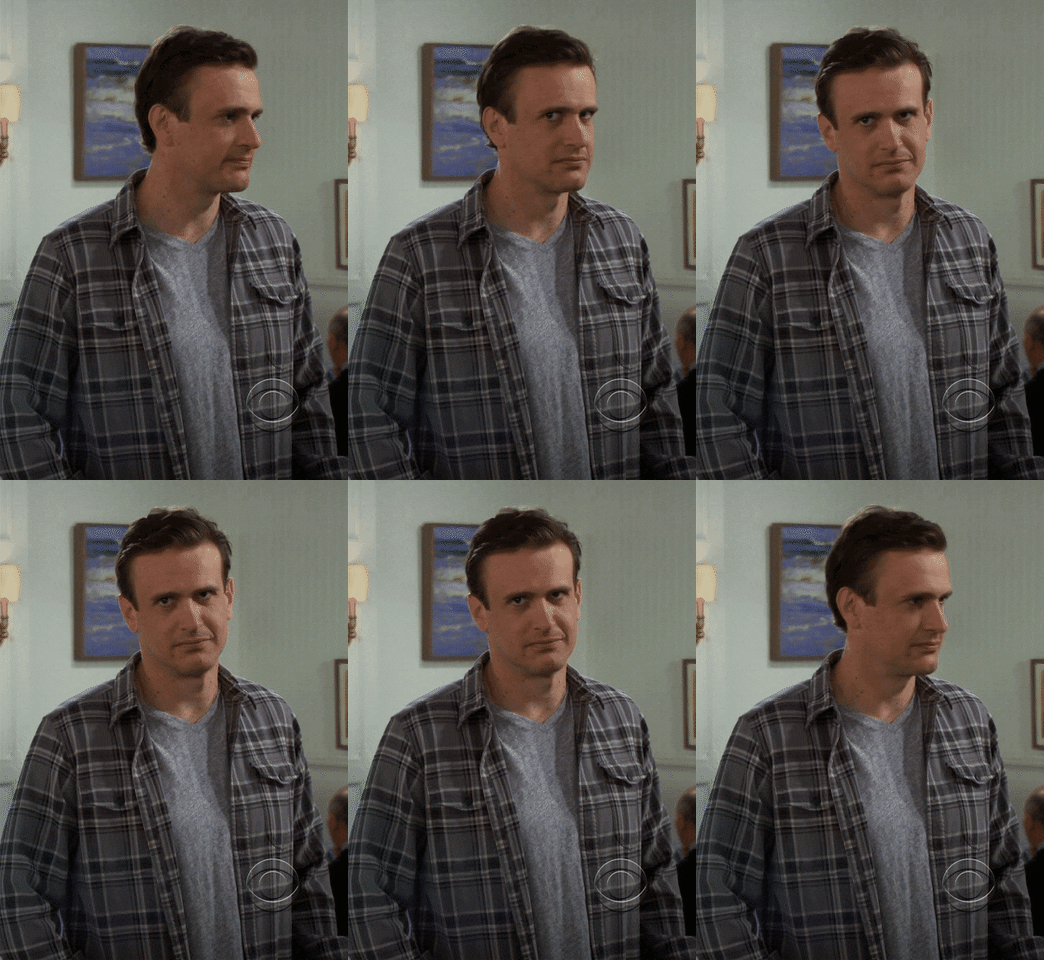
mrw guy watch annoyed how i met your mother


Okay, so maybe I'm a late bloomer on this one. But for real, y'all, this is a game changer. Just like cell phones, Myspace, Facebook, insert-anything-technological-here-that-I-discovered-years-after-everyone-else was. But hey! I just used a gif.

Besides the few audiobooks I've heard on road trips, this was my first non-vacational audio book for my listening pleasure around the house, at work, in the car, at Target...you get the idea. So while one of my new year's goals is to have a book, and not my phone, in my hands more, I consider this an ideological, if not technical, win. And anyway, Big Little Lies isn't the newest book on the block (2014). But it's recently gained traction, with an HBO mini-series coming in a few months.

I also don't know if Caroline Lee is just a particularly good narrator, but she captures the tone and personality of each character in a mind boggling way. And since everyone has an Australian accent, well, there's that.

On its face, we have a book about "kinder moms," as they're called. Or mothers whose kids will be starting kindergarten at the local school. Our setting? A beach town in Australia, where stay-at-home-dads and working mothers are more of a novelty than the norm. At the very least, it's a label worthy of attachment when talking about someone. And oh, is there plenty of that. If you're not one to tolerate idle chatter, busybodies, and speculative gossip, there's also an erotic book club, schoolyard bullying, and a murder investigation.

But wait! Stop that eye roll and hear me out! This book isn't as annoying as it could be. Moriarty tackles cliches and neighborhood drama with humor and complexity. She unfolds her characters much in the way you would get to know someone. We get a superficial perspective at first, maybe learn a thing or two, and then move on to someone else's story. But as the book progresses, you get one more tidbit about someone that changes your opinion about them. Much as you might realize a first impression about someone was completely wrong.

That was my reaction, for instance, to Madelyn, an overly assertive, opinionated kinder mom with a flair for drama. At first, I wasn't sure if I'd be able to handle her, even on the printed page. She's the kind of person that makes her presence known whether you like it or not, and who relishes the awkwardness of confrontation. She ended up being one of my favorite characters, because despite her propensity for stilettos and online shopping, her wit and sarcasm are spot on, and her personality not as shallow as it seemed.

Like Madelyn, Moriarty's other characters are deliciously complex and fully developed. Even her supporting cast is written clearly and distinctly, so that you really have an idea of who you like, don't like, and even hate to like, by the time she's done with everything.

Another thing I liked about this book is how Moriarty so perfectly captures how our outward actions and appearances don't always reflect our intentions or inward thoughts. She'll have someone fret over a look received after what she thought was a friendly smile, or describe how people join a race for a cause, when the real cause is their own waistline. Her characters say things, but mean others, and do things that are misinterpreted. She creates cringeworthy situations with a surprising ease that will make you laugh, and probably relate with a little too well.

And at its heart, Big Little Lies has a message. Moriarty takes the topic of bullying and tackles it from so many perspectives: on the schoolyard, at home, verbal, physical, in kids, in adults. Her style is so casual, you might not realize, until something happens to someone, how much you cared about them. And the way she writes about domestic violence is heartbreaking and eye opening.

I've heard Moriarty isn't a one-hit wonder, too. Her other books, like What Alice Forgot and The Hypnotist's Love Story are probably worth checking out. And I think I eventually will. Who knows, maybe it will be sooner rather than later now that I've discovered AUDIOBOOKS!!!

Tuesday, August 4, 2015

Follow You Home by Mark Edwards

I birthed a little person recently. So reading is about as much a priority as wearing a shirt right now. However, I have a lot of "down" time in the form of rocking and feeding said little person. So a free book on my Kindle was in order. Enter Follow You Home. It was on my Kindle. It was free. I didn't have to wear a shirt. Done.

I got through this book in two days, which is record time for me. I don't know if that says more about the book or more about the amount of feeding and rocking I was doing in those two days. This psychological thriller is about two young travelers, Daniel and Laura, who are experiencing Europe, until they get to the scary, sinister part of Europe (that would be the eastern bit). There (in Romania), they experience the Thing That Must Not Be Spoken Of and quickly end their trip.

Back home in London, Daniel and Laura try to go about their daily lives. But their once close relationship dissolves as each spirals into their own living hell in trying to deal with What Happened.  As Daniel tries to get over the loss of Laura, he experiences strange things, things he can't help but wonder might be connected to the fateful trip. Meanwhile, Laura not only withdraws from Daniel, but her grasp on reality seems to be slipping away.

Two stories in one, Edwards slowly reveals what happened to Daniel and Laura in Romania while simultaneously unfolding the resulting horror they both encounter back home. He keeps you guessing, is it something supernatural? Is it something depraved? Something real? Something imagined? And he unfolds both stories in such a way that there were times (usually in the middle of the night) where I was too creeped out to read (and I still got done in two days!).

Overall, this book was a great package. It was quick, captivating, and a bit scary. I'd be interested to read more of Edwards' other thrillers, shirt or not.