Showing posts with label contemporary. Show all posts

Sunday, February 15, 2026

The Night Guest by Hildur Knútsdóttir

After finishing this one, I thought, "well that was a sweet little horror novel." I'm not sure I can verbalize why sweet is the best word, but it really is. 

Maybe it's Mary Robinette Kowal's subtle hints of humor alongside the terror in her voice as she narrates Iðunn (pronounced Ethun) in Knútsdóttir's novella. I rooted for Iðunn and was horrified alongside her as events unfolded. I wanted Iðunn to wake up feeling refreshed, not like she just walked 5 miles or wrestled a bear. What other explanation could there be for the soreness, bruises on her body, and blood under her nails night after night?

Maybe it's the book's format of 100+ chapters - but many just a single sentence. It was nice not needing pages and pages of explanation and exposition. It's really quite simple, Iðunn isn't sleeping well. In her journey to figure out why, she tries psychotherapy, sleeping pills, insomnia, dating distraction, GPS, and a step-counting app. Despite the overall brevity, Knútsdóttir still managed to create someone you care for and seem to know pretty well. 

It definitely wasn't the sinister undertone of Iðunn's morning revelations.

Or the cats.

And it wasn't the reveal. Definitely not the reveal, which I'm a little flummoxed by, to be honest.

But somehow, at the end of the day, I was able to listen to this novella in a few hours and got a fun head scratcher out of it. Unconventionally, horrifically, sweet. 

Tuesday, August 28, 2018

And the Sea Called Her Name by Joe Hart

This is a great novella from Joe Hart about two people who start starry eyed, like any other couple, but slowly grow apart. Set on the blustery Maine coast, Hart describes Jason and Delphi in a quaint home on the seashore, with the cold, dark ocean just beyond their doorstep. We see events through Jason's eyes. A reluctant fisherman following in the steps of his father, Jason wants nothing more than to provide for his wife, Delphi, and build a family. But as Delphi becomes despondent and her behavior stranger and more unexplainable, Jason is hard pressed for any answer that makes sense.

After reading it, I thought, "Okaaaay?" As the ending was a bit fantastic for my taste. But then I read a blurb at the end that Hart wrote about what inspired the story. And that made me appreciate it a lot more. And my heart actually ached a little bit more, not just for Jason and Delphi, but for anyone who has experienced similar devastation, or alienation from a loved one, or complete loss. The symbolism Hart uses to show Jason and Delphi's unraveling is so out there, it shows the extreme ruin people go through emotionally.

So I guess I missed the point until Hart told me what it was. But a little reminder every now and then to look deeper than the surface is ok. And what better place to delve into the depths than the cold, black, sea.

Sunday, August 27, 2017

After the Crash by Michael Bussi

This is a great example of what happens when a boob man writes a mystery novel. While the story at hand is fine, there were times when I'd be reading about turbulence in an airplane and then...BAM! A flight attendant with an aged fleshy bosom enters the scene. Does this character have an important role in the events at hand? Not really. Is there something about her body that is relevant to what is occurring? Nope. Well, maybe the author is just trying to paint a word picture for us...why then does he not mention anything else about this person's appearance? So now I'm left trying to solve the mystery of the mention of said bosom rather than focusing on the story at hand.

And we are only on the 2nd paragraph people.

We are then introduced to another character whose huge tits and oversized mammaries are described in two consecutive sentences. And then this character catches a ride with an acquaintance who mentions how he used to get so turned on watching her try to hide her big titties when she was on TV (his words, not mine). A totally acceptable comment from your friend's gardener while riding for 5 minutes together in the car, so I'm led to believe.

So Nicole has big boobs, got it. I'll give Bussi a pass whenever he feels the need to wax poetic about them.

But then Nicole's grandson notices her picture on a wall, and Bussi decides "ample breasted" would be an appropriate way to describe her in the photo. Maybe it's just me, but it seemed weird coming in the context of thoughts from her grandson.

And, while not quite as eyebrow raising as the anatomical fixation, I found it strange that distances were described in miles in a book that took place in France.

Luckily for Bussi, he has an out, as this book was originally written in French. There's some plausible deniability going on that allows me to wonder if all of this is really just something that is lost (gained?) in translation.

Works for me.

Boobs, miles, and hints of possible incest aside, this book isn't half bad. If you're interested in solving the mystery of a 3 month old baby who is the sole survivor of a plane crash, and whose identity is questioned, this book will not disappoint. And despite what I've said, the mystery is primary here, so boob men are better off waiting for the on screen adaptation.

Wednesday, February 1, 2017

A Man Called Ove by Fredrik Backman

After finishing several audiobooks, I had gotten used to "reading" while accomplishing some other task. So it took several weeks for me to actually read this book, which was a Christmas gift. How time-consuming to SIT DOWN and READ an ACTUAL book...Could I truly devote ALL my attention to it? I was afraid I wouldn't get the kitchen cleaned or my email checked or God knows what else if I just READ the book myself. Oh no, is this what kids these days think about books? *high fives myself for bridging a generational gap*

Speaking of kids these days, Ove is the kind of curmudgeonly old man who would say exactly that. He yells at people and calls them names, never mind the people he DOESN'T like. But he saves his deepest ire for anyone who ignores the no driving sign between the row houses in his neighborhood. He is the sort of man who doesn't understand idle chatter, who judges another man by the car he drives, and whose (albeit reluctant) willingness to fix your radiator is a sign of his ability to tolerate you.

Mild spoilers ahead, but nothing that isn't revealed in the movie's trailer...

Ove's wife has died and so Ove doesn't see fit to live himself. But things keep getting in the way of his...attempts. Nosy neighbors, broken furniture, kids to yell at, that kind of thing. And in the story of the end of his story, we learn how he became mortal enemies with his former friend and neighbor, how he met his wife, how he got a cat he didn't want, as well as some back story on some neighbors.

A Man Called Ove is about the ups and downs that make up daily life. For such a simple premise, you'll want to keep reading nonetheless. I hate to call it a "feel-good" book, but that's kinda how it made me feel. And while it might not make you full on ugly cry, you may have to squeeze back a tear or two in moments both happy and sad. And besides all that, it makes you look at grumpy old men in a whole new way. And who doesn't need a little helping hand to bridge that generational gap, amirite?


Saturday, January 7, 2017

Big Little Lies by Liane Moriarty


Okay, guys. I'm going to tell you the biggest secret I've discovered so far for 2017...It will get you reading more books, faster than ever. Read on if you want your mind blown...it's...audiobooks.


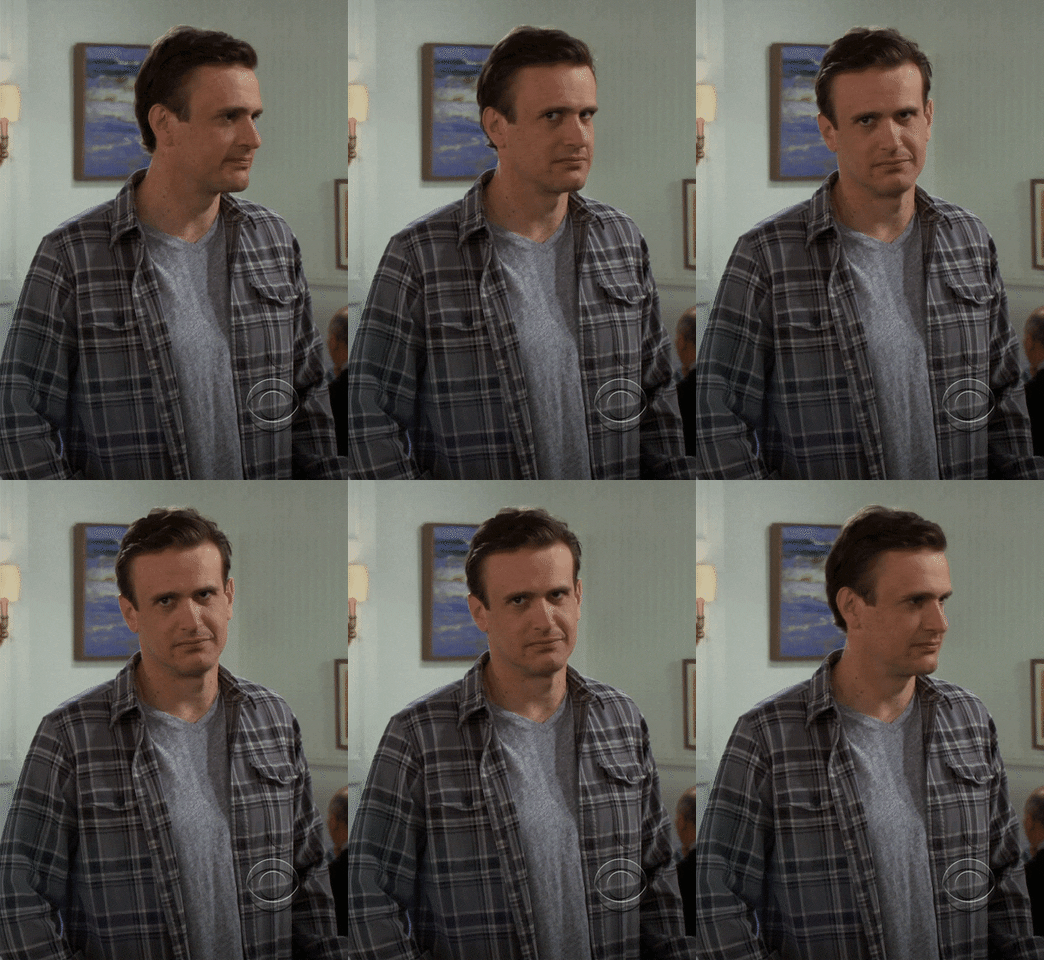
mrw guy watch annoyed how i met your mother


Okay, so maybe I'm a late bloomer on this one. But for real, y'all, this is a game changer. Just like cell phones, Myspace, Facebook, insert-anything-technological-here-that-I-discovered-years-after-everyone-else was. But hey! I just used a gif.

Besides the few audiobooks I've heard on road trips, this was my first non-vacational audio book for my listening pleasure around the house, at work, in the car, at Target...you get the idea. So while one of my new year's goals is to have a book, and not my phone, in my hands more, I consider this an ideological, if not technical, win. And anyway, Big Little Lies isn't the newest book on the block (2014). But it's recently gained traction, with an HBO mini-series coming in a few months.

I also don't know if Caroline Lee is just a particularly good narrator, but she captures the tone and personality of each character in a mind boggling way. And since everyone has an Australian accent, well, there's that.

On its face, we have a book about "kinder moms," as they're called. Or mothers whose kids will be starting kindergarten at the local school. Our setting? A beach town in Australia, where stay-at-home-dads and working mothers are more of a novelty than the norm. At the very least, it's a label worthy of attachment when talking about someone. And oh, is there plenty of that. If you're not one to tolerate idle chatter, busybodies, and speculative gossip, there's also an erotic book club, schoolyard bullying, and a murder investigation.

But wait! Stop that eye roll and hear me out! This book isn't as annoying as it could be. Moriarty tackles cliches and neighborhood drama with humor and complexity. She unfolds her characters much in the way you would get to know someone. We get a superficial perspective at first, maybe learn a thing or two, and then move on to someone else's story. But as the book progresses, you get one more tidbit about someone that changes your opinion about them. Much as you might realize a first impression about someone was completely wrong.

That was my reaction, for instance, to Madelyn, an overly assertive, opinionated kinder mom with a flair for drama. At first, I wasn't sure if I'd be able to handle her, even on the printed page. She's the kind of person that makes her presence known whether you like it or not, and who relishes the awkwardness of confrontation. She ended up being one of my favorite characters, because despite her propensity for stilettos and online shopping, her wit and sarcasm are spot on, and her personality not as shallow as it seemed.

Like Madelyn, Moriarty's other characters are deliciously complex and fully developed. Even her supporting cast is written clearly and distinctly, so that you really have an idea of who you like, don't like, and even hate to like, by the time she's done with everything.

Another thing I liked about this book is how Moriarty so perfectly captures how our outward actions and appearances don't always reflect our intentions or inward thoughts. She'll have someone fret over a look received after what she thought was a friendly smile, or describe how people join a race for a cause, when the real cause is their own waistline. Her characters say things, but mean others, and do things that are misinterpreted. She creates cringeworthy situations with a surprising ease that will make you laugh, and probably relate with a little too well.

And at its heart, Big Little Lies has a message. Moriarty takes the topic of bullying and tackles it from so many perspectives: on the schoolyard, at home, verbal, physical, in kids, in adults. Her style is so casual, you might not realize, until something happens to someone, how much you cared about them. And the way she writes about domestic violence is heartbreaking and eye opening.

I've heard Moriarty isn't a one-hit wonder, too. Her other books, like What Alice Forgot and The Hypnotist's Love Story are probably worth checking out. And I think I eventually will. Who knows, maybe it will be sooner rather than later now that I've discovered AUDIOBOOKS!!!

Thursday, September 15, 2016

A Head Full of Ghosts by Paul Tremblay

"How can ghosts be in your head?" my four-year-old asked me one day. I had been talking to my husband about this book, and my son overheard me. "Uhhh..." I began. How do you explain something like that to a kid? I tried my best with a preschool explanation of this book's title, all the while realizing that for many people, the topics in this book are not abstract at all, but disturbingly real.

While not a ghost story, this book is frightening. Told from the perspective of Merry Barrett, in her early twenties in the present day, the heart of this tale occurs fifteen years earlier, when Merry is 8. It is at this time that Merry's 14 year-old sister, Marjorie, spirals into darkness. Once Merry's playmate and confidant, Marjorie changes, her behavior turning more and more menacing. Stories Marjorie once made up of friendly animals turn to stories of monsters and death. Normal sisterly playtime is replaced with cryptic notes and nightly visits by Marjorie to Merry's bedroom as she sleeps. Although Merry keeps these things to herself, her parents take notice as well. Merry's mother believes Marjorie is sick and needs the help of medical and psychological doctors. Merry's father, however, seeks spiritual guidance.

What seems like any family, yours or mine, suddenly seems like any family you'd rather not be. Trembley writes the Barretts in such an accessible way, driving home the delicate balance upon which all our lives hang. The contrast between the sweet innocence of young Merry and the shocking devlishness of Marjorie is written so well, you'll find yourself as afraid as poor Merry was of what Marjorie will do next.

The story tilts toward the hyperrealistic side when Tremblay introduces an element that unfortunately is becoming all too familiar, reality TV. In a desperate attempt to save Marjorie, Merry's father teams with a production company to televise the family's life as they prepare to perform an exorcism. Yes. I said exorcism.

If this makes you want to check out, don't let it. It's not clear one way or another if Marjorie has schizophrenia or is in fact possessed. Regardless of the true diagnosis, the fact that both possibilities could present themselves similarly is what's truly terrifying and intriguing about this story.

There are a lot of angles in this book, and it keeps the story dynamic. Whether you relate with Merry as a child or an adult, or with her mother, father, or even Marjorie, you'll be just as eager to see everything unfold as if you were watching the family on reality television yourself (but because it's a book, it's even better!).

Definitely a solid recommend, I couldn't put it down.

And I hope that's a better explanation of the book than I gave my son.

Sunday, November 30, 2014

A Tale for the Time Being by Ruth Ozeki


When a barnacle covered bag washes ashore on a small island in British Columbia, Ruth is immediately drawn into the narrative of Nao, a 16-year-old from an ocean away in Tokyo, Japan.

Nao lived with her parents in California, where Silicon Valley and the California sun held nothing but hope and happiness for the Japanese family. But her father's job loss returned Nao's family to Japan, where she went from happy well-adjusted teenager, to a bullied outcast. Escaping the constant pinching, stalking, and even fake funeral put on by her entire class, Nao finds solace in her diary, which Ruth finds in a Hello Kitty lunch box in the bag on the shore. She writes as if to an unknown friend, sharing how her own thoughts of suicide are complicated by her father, who when he isn't sulking or making origami insects, is trying to depart his own now. 

Nao also writes extensively about her buddhist nun grandmother, Jiko. The Japanese equivalent of Yoda, Jiko guides Nao through contradictory one-liners and an extended visit to her mountain monastary.  Through the Tao of meditation and scrubbing old ladies' backs, Nao's energy focuses on her family's mythology, which includes a journey to World War II via Nao's great uncle's letters.

Back in boring land, Ruth delves into her own research, trying to locate Nao or anyone from her family. Ruth hopes to help Nao before it's too late. But is she already dead? Was she a tsunami victim? Does she even exist?

In a nutshell, this description from The Guardian does a great job: 

"If a Japanese-American writer who is also a Zen Buddhist priest wrote a post-Japanese tsunami novel, what themes might you imagine she would address? Biculturalism, water, death, memory, the female predicament, conscience, the nature of time and tide? Tick. All there. Throw in the second world war, the reader-writer relationship, depression, ecological collapse, suicide, origami, a 105-year-old anarchist nun and a schoolgirl's soiled knickers, and you have Ruth Ozeki's third novel, A Tale for the Time Being."

If that sounds like a lot, it is. Nao's story is intriguing enough, but Ruth annoyed me. She would internalize Nao's characteristics by talking like Nao and even fighting with her husband, Oliver, due to his inappropriate reaction to one of Nao's diary entries. One particularly grating moment was when Nao's diary essentially catches up with itself, and Ruth and Oliver are reading together by kerosene light (small island issues apparently) when one of them implores, "go on, don't stop." Sigh.

Ruth's part in the story aside, I liked reading about Nao and her family. There is a good mix of philosophy and even the supernatural that raised things a level for me. But Ruth's part in the story canceled that out. So in total, kind of like the bag that washed on Ruth's shore, this book was a mixed bag for me. There's a lot going on with an interesting story, yet it was a book I could put down.

Friday, January 25, 2013

American Gods by Neil Gaiman

The premise of this book is right up my ally...imagine that people who immigrated to the United States brought their gods, myths, and superstitions with them. Not just in spirit (no pun intended) but physically as well. As times and priorities shifted, the elves, fairies, and pagan gods (among others) were neglected for newer gods. This book is about an impending battle between the old world gods and the new world gods. Imagine Easter fighting a manifestation of Technology; or Odin, the All Father, fighting the god of modern day drugs.

Sounds good, right? Well, unfortunately, I read a different book. It took me months to get through it because I just wasn't interested, so I'd pick it up between reading other books. Not a good strategy because I'd forget what I had previously read and be completely lost. This would annoy me and so I'd only read a small bit, half assed, retaining nothing for the next time I'd pick the book up (in a month). It was a vicious cycle broken only by the last hundred pages or so, when the story picked up steam. Of course, when the mystery behind a major plot line was revealed, I had no idea what was going on.

So I did what most lazy readers do, I checked out the cliff's notes version of the story. Thank you Wikipedia. After reading the plot summary, I thought, "hmmmm....sounds like an interesting book. I should read it sometime."

I actually started reading the book again...but lost interest and haven't picked it up since.

Not sure this is a fair review...I've met a couple of people who really like this book. And it seems that if you are a fan of Neil Gaiman's work, you won't be disappointed (at least, that's what I hear).

As for me, too many characters for my little brain to keep track of, I guess. And a lot of build up to an anticlimactic end. Give me Coraline over American Gods any day.